
Saudi Arabia’s national digital transformation and Vision 2030 hyperscale investments are accelerating precisely as AI computing transforms the thermal profile of data halls. With high-density accelerator racks exceeding 40 kW to 100 kW, harsh ambient desert dry bulbs exceeding 50°C, and stringent municipal water conservation mandates, traditional air-only cooling is rapidly reaching physical limits. Here is how engineering leaders balance rack density, heat rejection, water consumption, and concurrent maintainability.
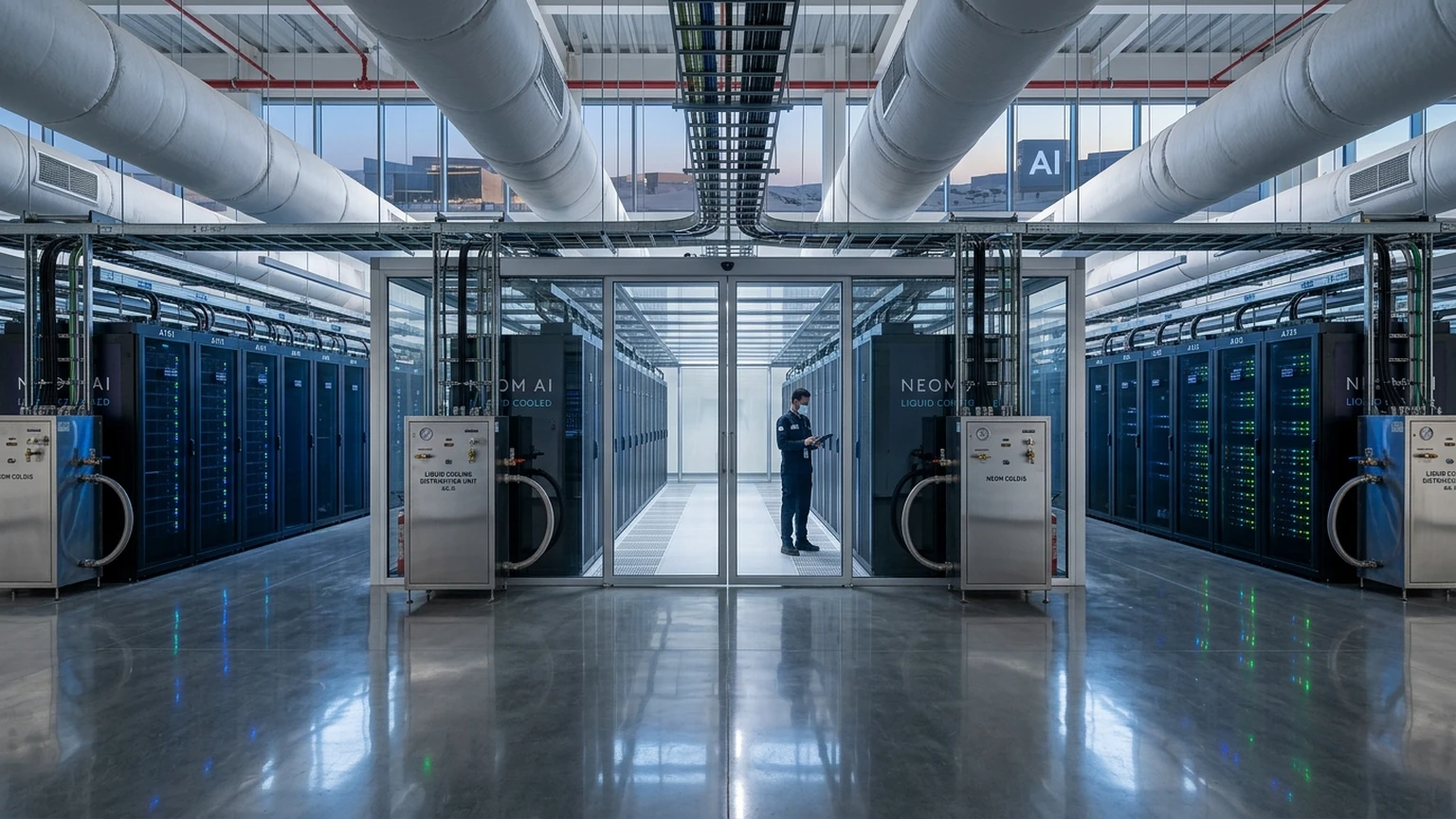
Transition point where air cooling fan power exceeds thermodynamic return, necessitating liquid-assisted architectures.
Achievable annualized Power Usage Effectiveness utilizing optimized heat rejection and variable-speed plant controls.
Water Usage Effectiveness benchmark balancing zero-water dry cooling against evaporative wet-bulb efficiency.
Tier III/IV redundancy ensuring secondary coolant loops (FWS/TCS) maintain uninterrupted IT uptime.
Traditional enterprise data centers in the GCC were engineered around relatively predictable, low-density IT equipment typically 4 kW to 8 kW per rack. Standard raised-floor Computer Room Air Handler (CRAH) or Computer Room Air Conditioner (CRAC) units comfortably flooded cold aisles to remove this heat.
However, modern GPU accelerators, high-density AI clusters, and compute nodes concentrate staggering heat fluxes, frequently ranging from 40 kW to upwards of 100 kW per enclosure. As density scales exponentially, delivering sufficient volumetric airflow through a conventional perforated floor tile becomes aerodynamically impossible without creating gale-force velocities, severe static pressure drops, and destructive fan power parasitics.
When facility managers attempt to handle high-density AI clusters using legacy cooling concepts, the operational symptoms appear immediately:
Severe temperature gradients where lower servers receive 19°C air while top servers ingest 29°C+ recirculated air.
Internal server fans ramp to 100% duty cycle, consuming up to 20% of total server power just fighting air resistance.
Conditioned chilled air short-circuits directly back to CRAC returns without passing through active IT chassis.
Data hall runs out of localized cooling capacity even when the central chilled water plant shows 40% spare tonnage.
Simply dropping central chiller setpoints to flood the room with 16°C supply air does not solve this localized distribution crisis. Instead, it forces central chillers to operate at penalizingly low thermodynamic lift, exponentially drives up electricity bills, and accelerates compressor wear while leaving localized hot spots completely unaddressed.
In mission-critical thermal design, every kilowatt of electrical power drawn by processors, memory banks, and power supplies is converted almost entirely into thermal energy. The fundamental engineering question is therefore not how many tons of cooling are installed in the central yard, but where that heat originates and what thermodynamic transport mechanism removes it.
Air cooling relies on convective heat transfer with air, an inherently poor thermal fluid with low specific heat capacity (approx. 1.005 kJ/kg·K). Liquid cooling, using treated water-glycol or engineered dielectric fluids, provides volumetric heat capacities more than 3,000 to 4,000 times greater than air. This fundamental physics enables liquid loops to collect high heat fluxes directly adjacent to the silicon die, bypassing room air entirely.
The newly published ASHRAE/NEMA/PNNL AI Data Center Energy Performance Framework (2026) and ASHRAE Standard 90.4-2025 mandate this integrated perspective. Facility electrical architectures, processor thermal thresholds, rack airflow dynamics, and central heat rejection can no longer be engineered in isolated silos. For Saudi operators, selecting the right cooling architecture requires balancing rack density, server technology roadmaps, redundancy tiers, and local water access.
A mission-critical data center does not reject heat into laboratory test conditions. It discharges heat into the demanding outdoor environment of the Arabian Peninsula. Designing heat rejection around nominal 35°C rating points guarantees derating or catastrophic thermal shutdown during peak summer operations.
In inland regions such as Riyadh, Qassim, and Al Kharj, outdoor dry-bulb temperatures regularly exceed 48°C to 50°C during peak summer afternoons. Under these extreme dry ambients, conventional air-cooled chillers suffer severe condensing pressure elevation, reducing compressor coefficient of performance (COP) and threatening high-pressure trips if coils are subjected to dust accumulation.
Conversely, coastal hubs such as Jeddah, Yanbu, Dammam, and Khobar present a completely different psychrometric profile: high ambient dry bulbs combined with elevated coincident wet-bulb temperatures (often exceeding 28°C to 30°C). In these marine microclimates, the evaporative potential of the air is drastically constrained, limiting the efficacy of direct evaporative techniques while saline airborne humidity accelerates condenser coil corrosion.
Engineering high-reliability heat rejection across the Kingdom requires simulating full 8,760-hour annual TMY (Typical Meteorological Year) psychrometric profiles, incorporating dust filtration strategies, variable-frequency condenser fans, and oversized heat exchanger coils to maintain design condensing temperatures even during peak ambient heat waves.
A frequent misconception among operators transitioning to high-density compute is assuming that adopting liquid cooling eliminates the need for air management. Even in advanced Direct-to-Chip (DLC) architectures, approximately 20% to 30% of total rack heat (from memory VRMs, storage drives, network interface cards, and internal power distribution) is still dissipated into room air.
Without rigorous airflow containment, this residual heat rapidly contaminates the white space. Cold supply air short-circuits into return plenums, while 45°C server exhaust air wraps around open rack slots into server intakes. Disciplined air management remains the baseline prerequisite for data hall stability:
A data hall can register a comfortable average room temperature of 21°C on wall thermostats and still experience catastrophic server throttling if local airflow containment is neglected.
Executive discussions regarding liquid cooling often falter due to oversimplified perceptions of risk—namely, the fear of routing raw untreated water directly over multi-million-dollar compute hardware. In reality, engineered liquid cooling relies on rigorously isolated, multi-tiered hydraulic boundaries:
1. Technology Cooling System (TCS): The secondary closed loop that circulates deionized water, specially inhibited propylene glycol, or dielectric coolant directly across microchannel cold plates clamped to CPUs and GPUs. This loop operates under controlled negative or low positive pressure with optical quick-disconnect dripless couplings.
2. Coolant Distribution Units (CDUs): Dedicated rack-mount or row-based units containing redundant variable-speed pumps, plate heat exchangers, continuous micron filtration, and automated fluid expansion reservoirs. The CDU thermally couples the TCS loop to the facility water loop without ever mixing the fluids.
3. Facility Water System (FWS): The building-level loop that transports heat from the CDU heat exchangers out to external chillers, dry coolers, or cooling towers.
Because direct liquid loops capture heat directly from high-density silicon, coolant leaving temperatures can safely reach 40°C to 50°C or higher. This high thermal quality expands free-cooling operating hours, drastically slashes refrigeration lift, and enables direct heat rejection even during hot Saudi summer days.
Indirect Evaporative Cooling (IDEC) has emerged as an attractive economizer technology for hyper-scale facilities in dry climates. By evaporating water in a secondary scavenger airstream, IDEC cools the primary data center air through an air-to-air heat exchanger without introducing any outdoor moisture, humidity, or airborne particulates into the white space.
In favorable inland desert climates (such as Riyadh, Tabuk, or Hail), where summer relative humidity frequently drops below 15% to 20%, IDEC systems can achieve wet-bulb depression efficiencies of 70% to 80%, providing substantial free sensible cooling and drastically reducing compressor run-time.
However, ASHRAE’s 2026 AI Data Center Energy Performance Framework explicitly highlights water-use effectiveness (WUE) and regional risk trade-offs when evaluating evaporative strategies. That emphasis is critical in Saudi Arabia. A data center cooling design cannot claim high efficiency based solely on low PUE if it consumes unsustainable volumes of potable water. Operators must account for water supply logistics, reverse-osmosis (RO) pre-treatment, bleed-off blowdown cycles, and regional water tariffs.
Selecting central heat rejection in the Kingdom represents a multi-variable engineering compromise between electrical demand, water availability, and operational maintenance:
Closed-Loop Dry Coolers: Eliminate operational water consumption entirely (WUE = 0.0 L/kWh) and prevent mineral scaling, legionella compliance requirements, and chemical treatment costs. However, during 50°C summer peaks, the heat-rejection temperature approaches ambient dry bulb, necessitating higher compressor work or warmer liquid supply temperatures.
Evaporative Cooling Towers: Reject heat toward ambient wet bulb (typically 22°C–24°C in Riyadh), yielding exceptionally high chiller COP and minimal electrical power draw. However, they consume significant water via evaporation and blowdown, requiring dedicated water treatment plants and anti-scaling biocides.
Hybrid Adiabatic Systems: Combine closed-loop finned coils with intermittent, automated water pre-misting activated only during extreme peak dry-bulb hours (e.g., above 38°C). This hybrid architecture protects compressors during extreme heat waves while preserving water during 85% of the year.
Historically, data center operators maintained excessively cold data halls (often 18°C–20°C supply) as a safety buffer against poor airflow distribution. Modern thermal guidelines from ASHRAE TC 9.9 permit server inlet temperatures within the Recommended Envelope (18°C to 27°C) and Allowable Envelope (up to 32°C for A1/A2 classes).
Every 1°C increase in chilled water or supply air setpoint yields an estimated 2% to 3% energy reduction in central chiller power by reducing thermodynamic lift and expanding economizer hours. However, setpoint optimization must be conducted with precision:
If server inlet temperatures are raised without verifying airflow distribution across every rack, the warmest server in a high-density cluster may breach internal thermal throttling thresholds. Furthermore, as server inlet air temperatures rise, internal server fans ramp up exponentially, a phenomenon where server fan power increases can easily erase chiller plant savings. Optimization must be governed by actual rack inlet telemetry rather than room-average setpoints.
High-density AI infrastructure requires an exhaustive, dependable telemetry layer. Modern Building Management Systems (BMS) and Data Center Infrastructure Management (DCIM) platforms rely on high-density sensor instrumentation to map thermal dynamics in real time:
Essential monitoring parameters include: top/middle/bottom rack inlet and exhaust temperatures; differential aisle static pressures; CDU primary and secondary loop delta-T and flow rates; pump and fan variable-speed RPMs; chiller power draw and true kW/ton efficiency; and real-time outdoor dry-bulb and wet-bulb conditions.
While AI-driven predictive control algorithms can forecast compute spikes, dynamically adjust chilled water setpoints, and identify degrading heat exchangers before failure occurs, automation must never become an unconstrained ‘black box.’ Supervisory control sequences must always operate within hard-coded physical safety envelopes, failover sequences, and manual operator overrides. Energy efficiency never justifies unmanaged uptime risk.
Evaluating high-density cooling architectures for Saudi facilities requires benchmarking thermal capabilities against hydraulic complexity, water impact, and climate suitability:
| Cooling Technology | Target Density | Heat Transfer Fluid | Water Usage (WUE) | PUE Impact | Saudi Operating Context |
|---|---|---|---|---|---|
| Perimeter CRAH with Containment | Up to 15 kW / rack | Conditioned Air | Zero (with Dry Coolers) | 1.30 – 1.45 | Standard for legacy data halls; severely limited for modern AI accelerators due to airflow volume limits. |
| Rear-Door Heat Exchangers (RDHx) | 20 – 50 kW / rack | Chilled Water / Glycol | Zero to Low | 1.18 – 1.25 | Excellent retrofit solution; neutralizes rack exhaust heat at the rear door without altering room airflow. |
| Direct-to-Chip Liquid Cooling (DLC) | 50 – 100+ kW / rack | Treated Water / Glycol (TCS) | Zero to Moderate | 1.12 – 1.18 | Industry standard for AI clusters; high fluid temperatures (45°C+) enable extensive dry-cooler free cooling even in KSA. |
| Indirect Evaporative Cooling (IDEC) | 15 – 30 kW / rack | Air-to-Air Heat Exchanger | Moderate (0.8 – 1.5 L/kWh) | 1.15 – 1.22 | Highly effective in dry inland regions (Riyadh); constrained in humid coastal microclimates (Jeddah/Dammam). |
The most thermodynamically efficient cooling design is worthless if a single pump or valve failure triggers a thermal excursion that trips high-density AI clusters. In mission-critical environments, efficiency must be engineered within the required reliability topology (such as Uptime Institute Tier III concurrent maintainability or Tier IV fault tolerance).
Critical secondary coolant distribution units (CDUs), primary circulating pumps, chiller compressors, and heat rejection coils must incorporate N+1 or 2N redundancy with automated, bumpless failover. For comprehensive insights into intelligent supervisory control and predictive resilience, explore EcoEdgeAI HVAC energy optimization controls and Windmason engineering services.
Before production servers arrive, data center cooling infrastructure must undergo rigorous integrated systems testing (IST). Commissioning teams must deploy electrical load banks across server rows to simulate 100% full-load thermal profiles across all seasonal ambient extremes.
Testing protocols must rigorously validate: instantaneous failover of redundant CDUs and pumps upon loss of utility power; variable-frequency drive staging; secondary coolant leak-detection response and automated isolation valves; and emergency thermal storage buffer ride-through during chiller restart cycles. Waiting for production workloads to reveal a control loop failure is unviable risk management.
If an engineering proposal for high-density data hall cooling answers only in terms of ‘tons of refrigeration,’ the design is fundamentally incomplete. Facility owners and operators should demand clear, verified answers to five strategic questions:
Will your facility accommodate evolving AI GPU roadmaps requiring 60 kW to 100+ kW per rack without requiring complete structural plant redesign?
What proportion of rack heat can be collected via liquid cold plates versus remaining residual air-cooled convection?
Has the heat rejection plant been modeled against local peak hourly dry-bulb and wet-bulb extremes rather than generic design points?
Does the operational expenditure model transparently account for both electrical tariff rates and potable water supply logistics?
Can a secondary loop leak, pump trip, or valve malfunction be isolated without dropping thermal capacity or breaching SLA commitments?
No. The necessity depends strictly on rack power density, processor heat flux, and IT hardware design. Standard compute racks below 20 kW can often be cooled effectively using optimized air containment and precision CRAH units. However, modern high-density AI accelerators exceeding 40 kW to 100+ kW per rack require direct liquid cooling (DLC) or hybrid rear-door heat exchangers because air cannot physically transport that heat density without excessive fan power and hot spots.
Yes, particularly in dry inland regions such as Riyadh, Hail, and Tabuk where summer relative humidity is low and substantial wet-bulb depression exists. However, operators must evaluate water-use effectiveness (WUE), municipal water tariffs, water filtration and scaling potential, and ensure backup dry cooling is available during high wet-bulb hours or water supply interruptions.
Treating room-average temperature as proof that every server rack is adequately cooled. An operator may see 21°C on a room wall thermostat while individual high-density servers experience hot air recirculation reaching 32°C+ at top rack inlets. High-performance thermal management requires monitoring rack inlet delta-T and differential pressures at the server boundary.
No. Running data halls colder than equipment specifications require wastes enormous amounts of energy. Under ASHRAE TC 9.9 guidelines, server inlet temperatures between 18°C and 27°C are recommended. Raising chilled water setpoints reduces chiller lift, saves 2% to 3% energy per degree Celsius, and expands economizer hours, provided airflow containment prevents localized hot spots.
Power Usage Effectiveness (PUE) alone is insufficient. Operators must measure Water Usage Effectiveness (WUE, L/kWh), cooling subsystem electrical breakdown (chillers, pumps, fans), server rack inlet/outlet delta-T, heat rejection operating hours per mode (economizer vs mechanical), and chiller plant true coefficient of performance (COP).
Mission-Critical HVAC & AI Thermal Management Specialists | Saudi Arabia
Specializing in high-density data hall thermal management, direct-to-chip secondary loop integration, precision heat rejection psychrometrics, and AI-enabled plant optimization across the Kingdom of Saudi Arabia.
Windmason Arabia conducts site-specific psychrometric analyses, rack airflow containment audits, liquid cooling readiness assessments, and energy/water optimization modeling for hyperscale and enterprise facilities across the Kingdom.