
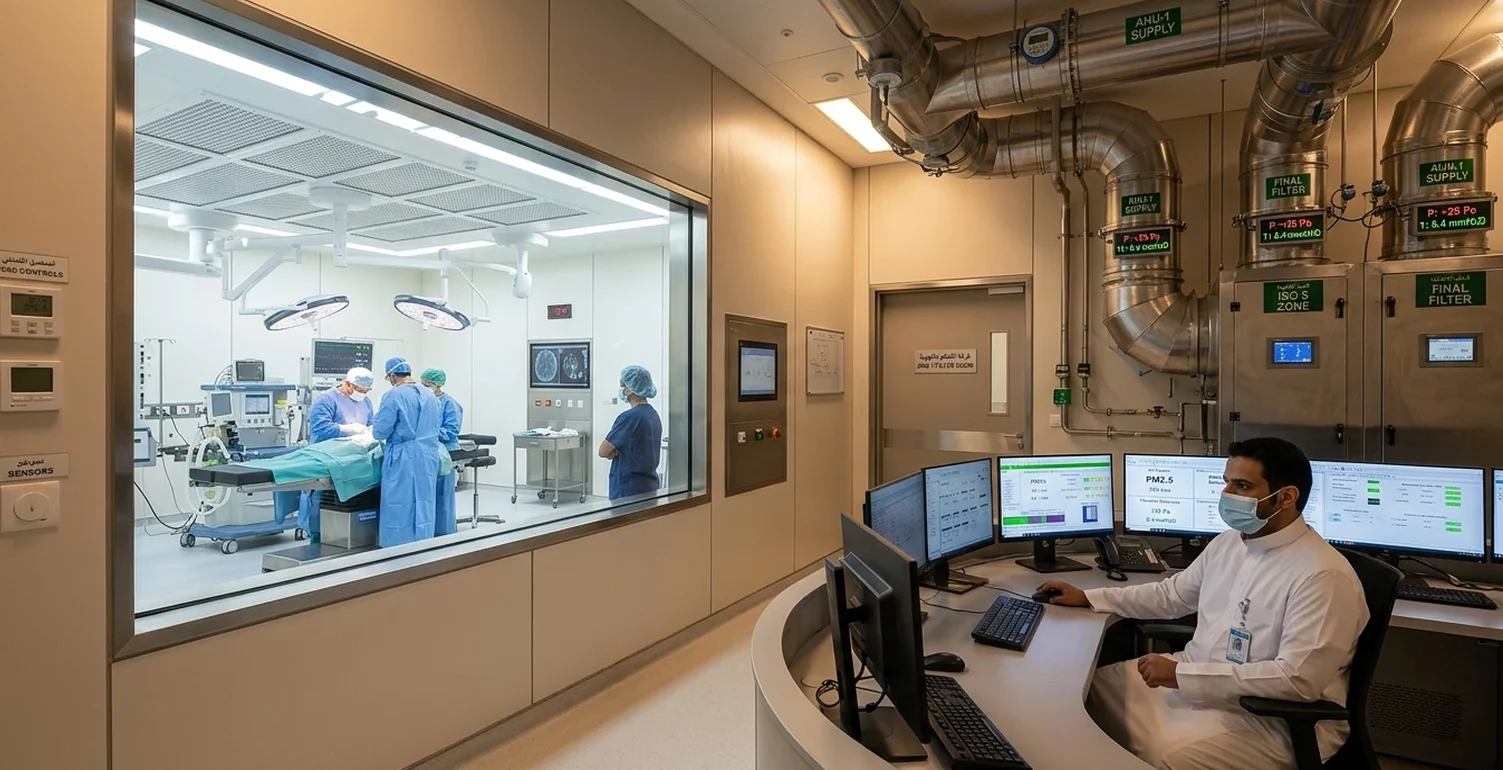
Hospitals are among the most energy-intensive, non-negotiable facilities in Saudi Arabia. Operating 24/7/365 under stringent clinical mandates, a hospital HVAC system must guarantee positive air pressure in surgical suites, negative pressure in airborne infection isolation rooms (AIIR), HEPA-level filtration, and strict relative humidity control. When healthcare executives demand utility reductions, the critical question is never how to cut airflow arbitrarily—it is how to eliminate parasitic mechanical waste while maintaining 100% clinical safety.
Governs ventilation rates, filtration efficiency, and directional pressure relationships across critical healthcare spaces.
Achievable hospital plant energy savings through chilled water optimization, non-critical scheduling, and static resets.
Minimum pressure differential required across isolation room boundaries to guarantee airborne pathogen containment.
Conditioning 100% fresh air via deep-dehumidification coils without cross-contaminating recirculated hospital air.
Hospitals cannot simply turn off their HVAC plants at 6:00 PM. Patient wards, intensive care units (ICUs), and emergency departments operate continuously. However, assuming that every single zone within a hospital complex requires the same inflexible, continuous ventilation is an expensive fallacy.
Over years of operation, hospital facilities accumulate ‘drift’—untracked manual setpoint overrides, repurposed clinical rooms operating under outdated airflow balances, stuck outdoor air dampers, and uncalibrated differential pressure transmitters. This invisible waste drives utility bills skyward without offering any clinical benefit:
Air handlers operating against unnecessarily high static setpoints due to legacy balancing or uncalibrated duct sensors.
AHUs delivering overcooled 12°C air to meet a single warm zone while electric or hydronic reheaters burn energy across other rooms.
Outpatient clinics, executive suites, and auditoriums running continuously on full critical-care air change rates overnight.
HEPA and pre-filters allowed to load past optimal resistance, forcing variable-speed fans to draw 30%+ excess power.
Addressing these challenges does not mean compromising infection control. It means establishing an authoritative room-by-room clinical requirements register, ensuring safety parameters remain locked while attacking mechanical inefficiencies in distribution and central plant operations.
In commercial office towers, engineering teams can adjust airflow setpoints, widen temperature deadbands, or cycle fans off during unoccupied hours. In healthcare environments, however, ventilation parameters are strictly dictated by ANSI/ASHRAE/ASHE Standard 170 (Ventilation of Health Care Facilities), Saudi Ministry of Health (MOH) regulations, and facility infection prevention policies.
Crucial clinical mandates include:
1. Operating Rooms (ORs): Positive pressure relative to all adjacent corridors (+2.5 Pa minimum), a minimum of 20 total Air Changes per Hour (ACH) with at least 4 ACH of outdoor air, HEPA terminal filtration (MERV 17+), and tight temperature (20°C–24°C) and relative humidity (20%–60% RH) control.
2. Airborne Infection Isolation Rooms (AIIR): Strict negative pressure (-2.5 Pa minimum) relative to anterooms and corridors, 100% dedicated exhaust directed outdoors away from fresh air intakes, and a minimum of 12 ACH to dilute infectious aerosolized pathogens.
3. Protective Environment (PE) Rooms: Positive pressure to protect immunocompromised oncology and bone marrow transplant patients from fungal spores and opportunistic environmental pathogens.
Energy optimization must operate strictly within these safe boundary conditions. Any proposal that seeks savings by shaving air changes below standard limits or jeopardizing pressure cascades is medically unviable.
A frequent pitfall in hospital energy retrofits is relying solely on a wall-mounted differential pressure sensor without verifying actual volumetric airflow balance. Differential pressure is a byproduct of the physical airflow delta: supply air volume minus return/exhaust air volume, factoring in room envelope airtightness, door openings, and duct leakage.
If an energy management system aggressively modulates supply fan speeds without synchronized tracking of dedicated exhaust fans, the pressure cascade can instantaneously collapse. A negative isolation room can flip positive, spilling airborne pathogens into nursing corridors.
Proper healthcare ventilation tuning relies on volumetric tracking VAV boxes with high-accuracy airflow measurement arrays (accuracy within ±5%), backed by continuous differential pressure monitoring. Control algorithms must maintain the necessary volumetric offset across all operating speeds, ensuring directional safety remains completely intact.
In Saudi Arabia’s dust-intensive desert atmosphere, hospital air handling units must manage heavy particulate loads. Multi-stage filtration, typically combining MERV 8 pre-filters, MERV 14 secondary bag filters, and terminal MERV 17+ HEPA diffusers, imposes substantial static resistance, often exceeding 500 to 750 Pascals (2.0 to 3.0 inches w.g.) across clean filter banks.
As dust and particulate matter accumulate, filter resistance rises exponentially. If supply fans are controlled to maintain constant airflow, the VFDs ramp fan motors to maximum frequency, significantly increasing kilowatt draw. According to ASHRAE/ASHE Guideline 43-2025 and DOE healthcare recommendations, changing filters based on real-time differential pressure telemetry rather than arbitrary calendar dates, prevents excessive fan power waste and prevents filter media blowouts.
Furthermore, ensuring rigorous filter housing sealing and airtight bypass latches is vital. A 2% air bypass around a HEPA filter frame completely invalidates cleanroom compliance while the fan expends full electrical energy pushing air through resistance.
Conditioning 100% outdoor air during Saudi summer conditions represents the single largest cooling penalty on a hospital central plant. Bringing 48°C ambient air down to 12°C supply conditions requires enormous refrigeration tonnage. In coastal cities like Jeddah and Dammam, extreme latent moisture loads require deep cooling for moisture extraction followed by reheat.
Energy Recovery Ventilation (ERV) can reduce this load by transferring sensible and latent energy from exhaust airstreams to incoming fresh air. However, in healthcare facilities, cross-contamination risks dictate system selection:
Explore Windmason’s certified medical-grade Fresh Air Handling Units (FAHU) and hygienic air systems.
While clinical zones require cautious airflow modulation, the central chiller plant offers extensive, risk-free energy conservation opportunities. Central chiller plants consume 40% to 55% of the total hospital electrical bill, and plant optimizations can be implemented without altering airflow to a single patient room.
Key chiller plant optimization strategies include:
1. Staging Based on True Part-Load COP: Staging chillers to operate at their peak efficiency window (typically 60%–80% load on magnetic bearing or variable-speed centrifugal machines) rather than running machines near full load.
2. Chilled Water Supply Temperature Reset: Dynamically raising chilled water supply temperatures from 6.0°C to 8.0°C during moderate ambient conditions when dehumidification loads allow. Each 1°C increase reduces compressor work by approximately 2% to 3%.
3. Primary-Secondary Pumping Optimization: Upgrading constant-volume secondary pumps to variable-speed drives governed by differential pressure sensors placed at the hydraulically most remote coil, ensuring minimum pump kilowatt draw.
For supervisory control and predictive plant optimization, discover EcoEdgeAI HVAC energy controls and Windmason engineering services.
Operating rooms are massive energy consumers because they require continuous 20+ ACH and 100% HEPA air filtration. However, during nighttime hours and scheduled surgical lulls, many ORs remain unoccupied for 8 to 12 hours.
ASHRAE Standard 170 allows airflow reductions during unoccupied periods, provided specific conditions are met:
• Positive pressure relative to surrounding spaces must be continuously maintained without interruption.
• Minimum air change rates cannot fall below approved safety baselines (e.g., maintaining at least 6–8 ACH).
• Relative humidity and temperature must remain within sterile instrument storage limits.
• Rapid recovery controls must automatically restore full surgical airflow (20+ ACH) within 10 to 15 minutes prior to surgical team entry.
Such sequences must be formally documented, risk-assessed, and signed off by hospital infection prevention committees, surgical leadership, and facility directors before activation.
Segmenting hospital departments by clinical sensitivity enables targeting high-yield energy conservation measures without compromising sterile environments:
| Healthcare Department | Pressure Cascade | Min Air Changes (ACH) | Filtration Standard | Energy Optimization Potential | Clinical Risk Profile |
|---|---|---|---|---|---|
| Operating Suites (OR) | Strict Positive (+2.5 Pa) | 20 ACH (4 Outdoor) | MERV 17+ (HEPA) | Moderate (Unoccupied setback to 8 ACH with fast recovery) | High — Requires Infection Prevention signoff |
| Isolation Rooms (AIIR) | Strict Negative (-2.5 Pa) | 12 ACH (100% Exhaust) | MERV 14 + HEPA Exhaust | Low — Maintain constant airflow and dedicated exhaust | Critical — Zero compromise on directional airflow |
| Inpatient Patient Wards | Neutral / Equalized | 6 ACH (2 Outdoor) | MERV 14 | Moderate — Nighttime static pressure & temperature reset | Low — Comfort & acoustic control prioritized |
| Central Chiller Plant | Non-Clinical Yard | N/A (Hydronic Plant) | Standard Chilled Water | High (15%–25% via VFD pumps, staging & lift reduction) | Zero — Operates completely outside patient areas |
| Administrative & Clinics | Standard Commercial | 2–4 ACH (ASHRAE 62.1) | MERV 8 / 13 | High (30%+ via night shutdown, VAV setbacks & DCV) | Zero — Standard commercial occupancy scheduling |
Hospital energy optimization succeeds when executed in a disciplined order of operations, capturing low-risk mechanical gains before touching advanced controls:
Recalibrate drifting pressure transmitters, fix leaking chilled water control valves, clean dirty cooling coils, and eliminate unauthorized manual overrides.
Conduct professional Testing, Adjusting & Balancing (TAB) to prove measured air change rates and pressure deltas match design intent before changing controls.
Program schedule-based setbacks and demand-controlled ventilation across administrative offices, auditoriums, outpatient clinics, and cafeteria spaces.
Implement automated chiller part-load sequencing, variable-speed secondary pumping, condenser water resets, and heat recovery loops.
Install continuous Fault Detection & Diagnostics (FDD) to alert engineering teams immediately if pressure relationships drift or simultaneous heat/cool occurs.
Only in designated spaces and under strict operational conditions approved by clinical and infection control leadership. Mandatory safety minimums—such as 20 ACH in operating rooms or 12 ACH in negative pressure isolation rooms—cannot be arbitrarily compromised. However, unoccupied operating room setbacks (reducing to 6–8 ACH while maintaining positive pressure) and scheduling non-clinical administrative areas provide safe, approved avenues for energy savings.
Optimizing the central chilled water plant and fresh air handling units. Because hospitals run continuous baseload cooling, small improvements in chiller staging, variable-speed pumping, supply water temperature resets, and run-around heat recovery loops generate substantial kilowatt-hour reductions without altering conditions inside sensitive patient care areas.
Hospital HVAC systems utilize multi-stage high-efficiency filtration, including HEPA filters. As dust accumulates, resistance increases dramatically, forcing supply fans controlled by airflow setpoints to ramp up motor speed. Unnecessarily delaying filter replacement leads to excessive fan power consumption and increases risk of air bypass around dirty filter frames.
Yes, provided cross-contamination risks are physically engineered out. Run-around hydronic coil loops are widely utilized in healthcare because they separate exhaust and outdoor supply airstreams across completely closed fluid piping, preventing airborne pathogen carryover. Rotary enthalpy wheels, however, carry leakage risks and are generally avoided on contaminated healthcare exhaust streams.
Only within strictly defined physical safety envelopes and fail-safe protocols. Healthcare BMS automation must enforce hard limits on differential pressures, minimum air change rates, and temperature/humidity boundaries. Energy algorithms must maintain complete transparency and allow manual facility operator override at all times.
Hospital HVAC Optimization & Clinical Air Quality Specialists | Saudi Arabia
Specializing in clinical ventilation design, operating room pressure cascades, fresh air deep-dehumidification (FAHU), and central chiller plant optimization for tertiary hospitals and medical cities across the Kingdom of Saudi Arabia.
Windmason Arabia provides specialized healthcare HVAC audits, pressure cascade validations, hygienic air handling equipment, and chiller plant optimization modeled for Saudi Arabia’s medical facilities.