
HVAC condensate recovery Saudi Arabia projects should match measured water production with a safe, defined non-potable use.
HVAC condensate recovery in Saudi Arabia can turn a routine drainage stream into a useful non-potable water source. Whenever a cold cooling coil removes moisture from humid air, liquid water forms on the coil, runs into a drain pan and usually disappears into the drainage system.
In a small dry-climate office, the quantity may be modest. In a coastal hotel, hospital, mall, university or fresh-air system, the volume can become significant during humid months. That creates a straightforward customer pain point: the building pays for desalinated or municipal water while potentially useful condensate is being discarded.
The solution is not simply to connect a pipe to a tank. Yield changes with weather and load, and water quality changes as condensate touches coils, pans, drains, pumps and storage. A credible system must quantify the water, match it to a safe end use and control the complete collection chain.
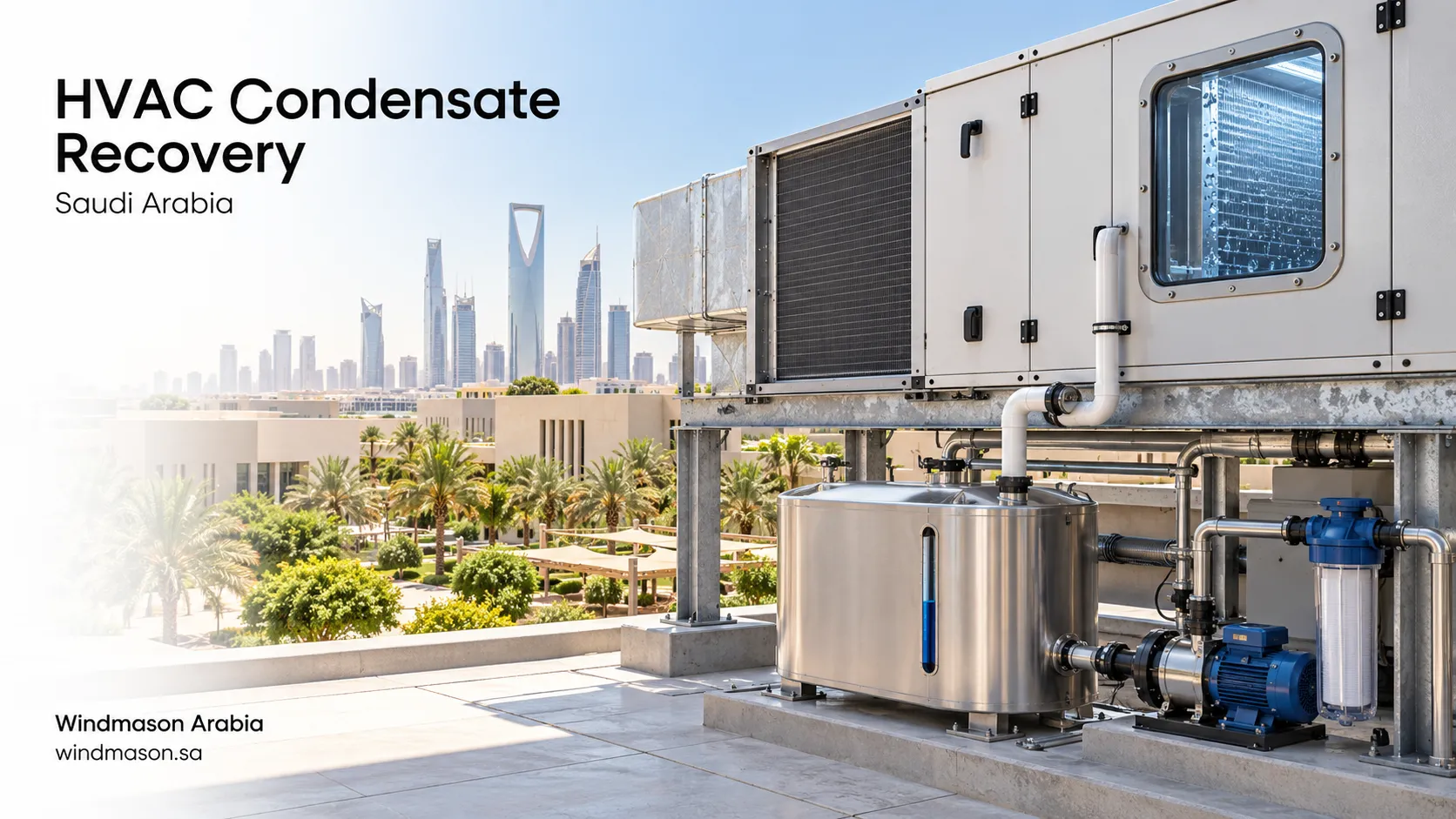
Condensate forms when moist air contacts a surface below its dew-point temperature. In HVAC systems, this normally happens on DX, chilled-water, VRF indoor-unit or dehumidification coils. Fresh-air AHUs and FAHUs can produce substantial condensate because they process humid outdoor air.
This distinction matters for Windmason’s portfolio. A basic evaporative-only IDEC system cools by evaporating water into an air stream; it does not necessarily create a condensate stream. A hybrid IDEC system with a mechanical cooling or dehumidification stage may generate condensate at that coil. Recovery claims therefore need to identify the exact stage and operating mode.
Relevant equipment context includes Windmason’s AHU and FAHU solutions, DX rooftop package units and project-specific hybrid cooling systems. The condensate opportunity belongs to the cooling coil, not automatically to every cooling product.
Condensate production is driven by moisture removal, not cooling capacity alone. Jeddah, Dammam and other coastal locations often experience higher humidity ratios and dew points than Riyadh. A fresh-air coil in Jeddah may remove much more moisture than a similar coil serving an inland building, even when both have similar sensible cooling loads.
A peer-reviewed Jeddah study reported annual collected quantities of 20,614 litres from its split-AC group and 8,725 litres from its window-AC group. A separate King Abdulaziz University simulation estimated 5,450 litres annually from a modeled 1.5 TR unit in Mecca. These results demonstrate potential, but they are not universal production factors.
The right forecast uses hourly outdoor dry-bulb and humidity data, supply airflow, outdoor-air fraction, coil leaving condition, operating schedule and internal latent loads. A field pilot with a calibrated water meter is even better.
Condensate is often low in dissolved minerals, but it is not automatically clean or safe. Dust, metals, biofilm, cleaning chemicals, insects and microorganisms can enter after condensation. Use must therefore be selected on a fit-for-purpose basis.
Potable reuse should never be the default sales proposition. Even when a sample meets selected chemical limits, drinking-water approval requires a validated treatment train, microbial risk control, continuous monitoring and compliance with Saudi regulations. Non-potable reuse normally offers a simpler starting point.
There is no honest litres-per-ton rule that works everywhere. The U.S. EPA’s June 2026 summary provides an early screening example: a 100,000 ft² building in a humid zone—or a 200,000 ft² building in an arid zone—can produce about one million U.S. gallons of AC condensate annually. It is useful for showing scale, not for sizing a Saudi tank.
Field evidence also varies widely. A 2025 university study in coastal Egypt extrapolated approximately 6 m³/day across 113 air conditioners during a high-production period. An August 2026 Mexican installation recovered about 520 litres/day from twenty-six 24,000 Btu/h units.
For a Saudi feasibility study, calculate three quantities:
A large annual condensate total does not justify a large tank if irrigation demand occurs at different times or if long storage creates water-quality risk.
List AHUs, FAHUs, fan-coil units, VRF indoor units and DX equipment. Record drain size, elevation, accessibility and operating hours. Exclude drains that may receive chemicals or contaminated process water.
Install temporary or permanent meters at representative drains. Compare flow with outdoor dew point, airflow and cooling-valve or compressor status. At least one humid-season dataset is valuable for coastal projects.
Sample fresh coil condensate, the collection header and stored water. Testing only the cleanest point can hide contamination introduced by the system. Parameters should follow the intended use and authority requirements.
Treatment should be designed around the receiving application. Cooling-tower makeup, irrigation and toilet flushing have different chemical, microbiological and operational requirements.
Maintain drain traps and slopes, prevent stagnant sections, use compatible materials and provide screened vents, accessible cleaning points, overflow, drainage and backflow protection. Storage must not compromise the original condensate-drain function.
A project may require sediment filtration, disinfection, activated carbon, pH correction or other treatment. Monitoring can include flow, tank level, conductivity, turbidity, disinfectant residual and scheduled laboratory testing.
Verify flow under real humidity, test overflow and low-level modes, prove makeup-water backup, check pump energy, confirm alarms and document cleaning frequency. Commissioning should show litres recovered and litres actually reused—not only tank capacity.
Fresh condensate may resemble distilled water in mineral content. KAUST researchers reported conductivity as low as 18 μS/cm and turbidity of 0.041 NTU in selected Saudi samples. However, low dissolved solids can make water aggressive toward some metals, and mineral-poor irrigation water may affect soil behavior unless blended or managed correctly.
The 2024 Jeddah study found its tested chemical parameters within the selected limits and only non-pathogenic bacteria in three window-unit samples. That is encouraging local evidence, but it does not establish universal safety. A dirty drain pan or warm storage tank can change conditions rapidly.
Facility teams should integrate condensate recovery with their building-water management and maintenance programmes. ASHRAE Guideline 12 addresses Legionellosis risk in building water systems, while the site’s adopted Saudi requirements and health authority rules remain controlling.
A simple recovery system can operate with level controls, but larger facilities benefit from BMS integration. Useful points include condensate flow, tank level, pump status, conductivity, treatment alarms, overflow events and potable makeup volume.
Analytics can compare recovered supply with cooling load and outdoor humidity, detect a blocked drain or failing pump, and forecast when storage will be full. Windmason’s EcoEdgeAI and BMS integration can provide a broader optimization context where compatible meters and controls are available. Any saving claim should be based on measured displaced water, pump energy, treatment cost and local tariff.
Condensate is a byproduct of cooling, so the chiller’s base electricity should not be assigned to water recovery. The recovery project still has capital and operating costs: collection pipework, tanks, pumps, treatment, controls, testing, cleaning and component replacement.
Calculate annual value from the volume of purchased water and wastewater charges actually displaced. Add any verified cooling-tower or process benefit, then subtract pumping, treatment and maintenance. Model low-humidity months and periods of reduced occupancy. A defensible business case uses conservative recovered volume and includes a bypass when water quality is outside limits.
Windmason Arabia can support source mapping, psychrometric yield estimation, field measurement, treatment coordination, controls, installation, TAB and commissioning through its HVAC and MEP services. For cooling-tower applications, the design can be coordinated with Windmason’s cooling-tower solutions.
The engineering objective is not to collect the maximum theoretical water. It is to deliver a reliable quantity of fit-for-purpose water without creating drainage, hygiene, corrosion or maintenance problems.
Not automatically. Condensate can acquire metals and microorganisms from coils, pans, drains and storage. Potable use requires approved treatment, validation, monitoring and regulatory compliance.
A basic evaporative-only IDEC stage normally consumes and evaporates water rather than condensing it. A hybrid system may produce condensate at a separate mechanical cooling or dehumidification coil.
It can be useful because it is often low in dissolved solids, but corrosion, microbiology, treatment chemistry and the total tower water balance must be reviewed.
Coastal cities such as Jeddah and Dammam generally offer stronger potential because humidity is higher. Actual production still depends on airflow, outdoor-air fraction, load and schedule.
Measure condensate flow, outdoor humidity, equipment runtime and the demand of the proposed end use. Test water quality at the coil, collection header and storage tank.
Start by measuring condensate production during representative humid operation and comparing it with a defined non-potable demand. Sample water at the coil, collection header and storage tank because quality can change along the route. Tank sizing should reflect simultaneous supply and demand, cleaning access, overflow management and the maximum safe storage period.
HVAC condensate recovery in Saudi Arabia can reduce demand for desalinated or municipal water, particularly in large coastal facilities. Recent research confirms that meaningful volumes are possible, but it also confirms that quality testing and sound methodology matter more than optimistic estimates. The most credible project begins with a humid-season measurement campaign, selects a controlled non-potable use, designs safe storage and treatment, and proves performance through meters. That approach converts water once treated as waste into a documented sustainability result. CTA: Ask Windmason Arabia to assess your AHUs, FAHUs, DX or VRF systems for condensate-recovery potential. We can help quantify supply, match it to a suitable use and develop a practical HVAC/MEP integration plan. Contact Windmason Arabia.
Sustainability (2026): implemented condensate recovery system Discover Water (2026): multi-criteria condensate review U.S. EPA Water Reuse Action 4.5 summary (2026) Jeddah condensate quality and quantity study Large-institution condensate field study (2025) KAUST Saudi condensate research
Filename: hvac-condensate-recovery-saudi-arabia.webp Alt text: HVAC condensate recovery system collecting water from an AHU in Saudi Arabia Filename: ac-condensate-water-reuse-process.webp Alt text: AC condensate collection filtration storage and non-potable reuse process Filename: jeddah-hvac-condensate-monitoring-dashboard.webp Alt text: Jeddah facility dashboard tracking HVAC condensate flow and storage level
Unique topic, focus keyphrase and slug; distinct from the evaporative-cooling water-use and chiller-heat-recovery editions. Focus keyphrase appears in the title, slug, H1, opening paragraph, body and conclusion. Meta description is within a typical search-snippet length and states the benefit plus risk-control angle. Short paragraphs, descriptive H2/H3 headings, table, numbered process and FAQs improve readability. Semantic phrases cover AC water reuse, Jeddah, cooling-tower makeup, non-potable reuse and water conservation. Contextual internal links point to Windmason AHU/FAHU, DX units, cooling towers, EcoEdgeAI, services and contact.