
Evaporative cooling creates a question Saudi facility owners are right to ask early: “How much water will it use?” The wrong answer is either claiming water use is negligible or dismissing evaporative systems because water is scarce. In Saudi Arabia, severe summer temperatures generate massive cooling loads. The correct engineering framework evaluates energy, water quality, makeup volumes, blowdown controls, and lifecycle operating costs together—treating evaporative cooling water use as a calculated, metered, and controlled design variable.
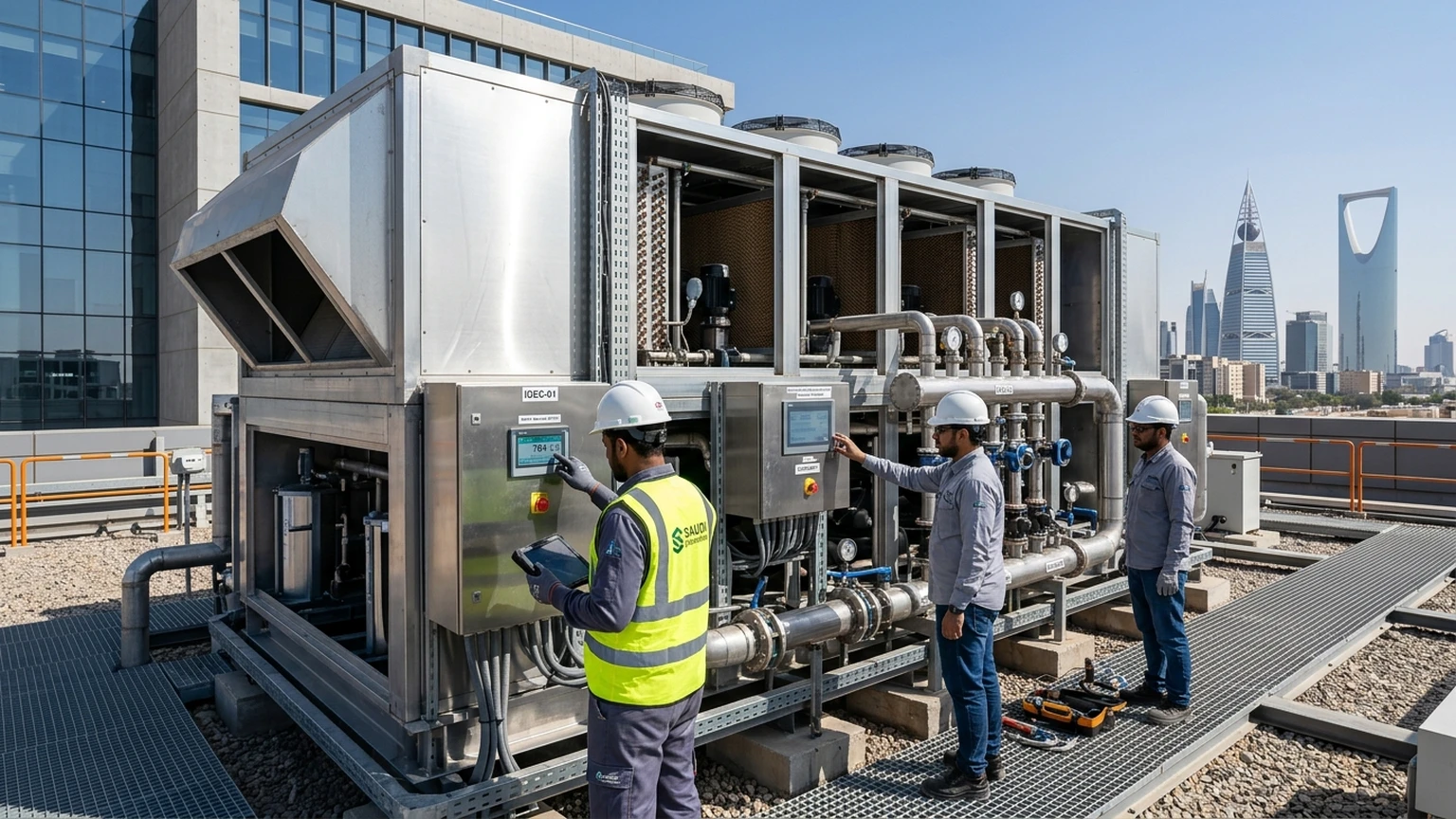
Direct phase-change water consumption required to deliver one kilowatt-hour of useful refrigeration cooling.
Drastic reduction in mechanical chiller electrical demand achieved through indirect evaporative pre-cooling in KSA.
Optimal cycles of concentration achieved through automated conductivity-based blowdown, reducing bleed by 67%.
True indirect evaporative stages cool primary supply air across sealed heat exchangers with zero added humidity.
Evaporative cooling creates understandable hesitation among facility owners in the Kingdom. Water is a strategic national resource, and mismanaging it carries environmental and financial penalties. However, engineering decisions often suffer from two extremes:
Some vendors downplay water requirements, claiming consumption is negligible. Others dismiss evaporative cooling entirely, defaulting to 100% mechanical compressor cooling that causes massive electrical grid peaks. High-performance operation requires eliminating these common misconceptions:
Assuming evaporative systems run on closed loops without accounting for blowdown and mineral buildup leads to surprise utility bills and scaled equipment.
Dismissing evaporative technology outright forces buildings into 100% mechanical DX cooling, overloading electrical grids during peak 48°C summer days.
Leaving a manual drain line partially open wastes thousands of cubic meters of fresh water annually without maintaining proper mineral control.
Confusing pump recirculation flow (150 L/min) with actual makeup water consumption (1.5 L/kWh) leads to drastically exaggerated water impact estimates.
For owners seeking verified indirect evaporative cooling configurations, Windmason’s IDEC product family provides engineered options ranging from standalone industrial evaporators to multi-stage indirect-direct equipment.
In an evaporative HVAC cooling process, water changes phase from liquid to vapour, absorbing approximately 2,260 kJ per kilogram (the latent heat of vaporization). That evaporation is the useful thermodynamic mechanism that depresses the air temperature. Depending on the system architecture, water also exits the equipment through bleed/blowdown to control dissolved mineral concentration, through drift if mist separators are substandard, or through piping leaks.
This distinction matters immensely. “Water consumption” cannot be represented merely by sump volume or pump recirculation rate. Recirculation flow through the heat-exchange matrix is not consumption—it circulates continuously. True consumption equals useful evaporation plus controlled blowdown and unavoidable operational losses. For facility engineers, the only auditable metric is makeup water metered over time.
1. Useful Evaporation: Phase-change heat absorption that directly cools the primary airstream. Approximately 1.2 to 1.8 litres per kWh of thermal cooling delivered under typical summer conditions.
2. Managed Blowdown (Bleed): Water discharged to purge concentrated dissolved minerals (TDS) and silica. Fully controllable via automated solenoid valves and conductivity sensors to achieve high cycles of concentration.
3. Drift & Avoidable Losses: Droplets carried off mechanically by exhaust air. High-efficiency drift eliminators reduce drift to less than 0.005% of circulating water, eliminating water waste and exterior biological risks.
Evaporative cooling efficiency depends fundamentally on outdoor psychrometric conditions. A 46°C dry-bulb afternoon in Riyadh with 15% relative humidity (coincident wet-bulb around 20°C–22°C) offers an immense wet-bulb depression of 24°C to 26°C. In contrast, an afternoon in Jeddah with 38°C dry-bulb and 65% relative humidity has a wet-bulb temperature exceeding 30°C, drastically compressing evaporative cooling potential.
Dry-bulb temperature alone is completely insufficient for equipment sizing. When equipment selection claims rely on favorable dry conditions, annual water and energy predictions become distorted. Saudi facilities require location-specific 8,760-hour bin weather simulations:
Central & Northern Regions (Riyadh, Qassim, Hail): Extreme dry-bulb (42°C–48°C), low coincident wet-bulb (19°C–23°C), huge wet-bulb depression (22°C–26°C). Indirect evaporative stages routinely produce 18°C–21°C supply air without mechanical refrigeration. High water efficiency with COP exceeding 8.0 to 12.0 during peak hours.
Coastal Regions (Jeddah, Yanbu, Dammam, Khobar): High dry-bulb (38°C–44°C) combined with severe absolute moisture content (wet-bulb 28°C–31°C). Direct evaporative stages cannot achieve comfort. Requires multi-stage hybrid configurations such as Supercool 4-Stage with integrated mechanical DX/chilled-water coils for moisture removal.
Windmason engineers configure multi-stage setups including the Supercool 3-Stage and Supercool 4-Stage to address specific regional psychrometrics, airflow volumes, and water availability.
A water-efficient design that results in a huge surge in compressor electrical demand is not sustainable. Conversely, an energy-saving cooling system that consumes excessive water or scales up under poor water quality is equally flawed. In Saudi Arabia’s industrial and commercial sectors, energy and water must be calculated on an integrated lifecycle balance sheet.
Recent frameworks by ASHRAE—particularly the AI Data Center Energy and Thermal Efficiency Framework—state this design principle with crystal clarity: energy, water, and resilience trade-offs must be evaluated together rather than optimizing a single resource metric.
In Saudi Arabia, municipal potable water is generated primarily via thermal desalination or seawater reverse osmosis (SWRO). Modern SWRO consumes approximately 3.0 to 4.5 kWh of electrical energy per cubic meter (1,000 litres) of produced water. When an IDEC unit consumes 1.5 litres of water to eliminate 1.0 kWh of direct chiller compressor electricity, the net national energy balance saves over 0.99 kWh of electricity even after accounting for the full embodied energy of water desalination!
Engineers must establish a shared annual baseline comparing kWh consumed, peak kVA demand, cubic meters of makeup water, chemical treatments, and maintenance amortizations using verified local SEC commercial electricity tariffs and NWC water rates.
Water carries dissolved solids: calcium, magnesium carbonates, sulfates, silica, and chlorides. When water evaporates, it leaves 100% of these dissolved minerals behind in the sump. Over hours of continuous operation, mineral concentrations climb steadily. If left unmanaged, mineral saturation results in scale deposition on heat-transfer surfaces, choking airflow channels and drastically diminishing heat transfer.
This is why raw makeup-water lab analysis is mandatory during preliminary design. Testing must quantify total dissolved solids (TDS), total hardness, electrical conductivity, silica, pH, and chloride content. Never wait until commissioning to discover that raw municipal or borehole water contains 1,200 ppm TDS and high silica levels.
Total Dissolved Solids (TDS): Target raw water < 300–500 ppm; sump operating concentration maintained below 1,500–2,000 ppm via blowdown.
Calcium & Magnesium Hardness: Softening or anti-scalant chemical dosing prevents calcium carbonate crystal precipitation on evaporative media.
Silica Concentration: In arid Saudi groundwater, dissolved silica must be kept below 150 ppm in the recirculating sump to avoid glass-like scale that cannot be chemically dissolved.
Biological Control: Automated biocide dosing or inline UV disinfection prevents biofilm, slime, and Legionella proliferation in warm sumps.
Recirculating evaporative systems utilize blowdown (continuous or timed bleed) to limit mineral concentration. Too much blowdown wastes expensive water; too little leads to rapid mineral precipitation and scale fouling. In modern engineering practice, blowdown is treated as an active control loop variable rather than a manual bleed valve left half-open.
The foundational metric is Cycles of Concentration (CoC), defined as the ratio of dissolved solids in the recirculating sump water to the dissolved solids in the incoming makeup water:
Cycles of Concentration (CoC) = TDS(sump) / TDS(makeup)
Makeup Water Volume (M) = Evaporation (E) + Blowdown (B) + Drift (D)
Blowdown Requirement (B) = E / (CoC – 1)
Thermodynamic Insight: Increasing CoC from 2 to 4 reduces required blowdown volume by 66.7%! Beyond 5 to 6 cycles, however, diminishing returns occur while scaling risk escalates exponentially.
Integrating automated conductivity controllers linked to motorized drain solenoids allows the BMS to discharge sump water only when electrical conductivity crosses a calibrated threshold, eliminating continuous manual overflow waste.
A single leaking float valve or jammed bypass actuator can quietly waste thousands of litres of water per day, completely destroying a facility’s projected water-energy economics. A drifted conductivity probe can trigger nonstop blowdown, draining treated water continuously to the sewer.
Preventive maintenance is therefore an active water conservation discipline. Facility operational protocols must incorporate routine sensor calibration, manifold inspection, and digital water meter logging:
Digital Pulse Water Meters: Dedicated sub-metering on the makeup pipe logs litres consumed per operating hour into the central BMS.
Bi-Monthly Probe Calibration: Cleaning and recalibrating toroidal conductivity sensors prevents erroneous blowdown cycling.
Uniform Water Distribution: Regular cleaning of spray nozzles and distribution troughs avoids dry streaks on heat exchangers, preserving heat transfer efficiency.
Automated Dry-Out Cycles: Sump drain-down sequences during unconditioned nighttime hours prevent mineral buildup and biological colonization.
Facility operators seeking comprehensive operational support can leverage Windmason’s professional HVAC engineering services for systematic testing, commissioning, water treatment audits, and performance verification across the Kingdom.
A frequent objection raised against evaporative cooling in commercial buildings is indoor humidity. Traditional direct evaporative cooling (DEC) introduces moisture directly into the supply airstream, creating clammy indoor conditions when outdoor wet-bulb temperatures rise.
Indirect Evaporative Cooling (IDEC) fundamentally decouples heat transfer from moisture addition. In the primary indirect heat exchanger, the primary air passes through dry channels while water evaporates in isolated secondary scavenger channels. Sensible cooling occurs across polymer or aluminum heat-exchanging plates without adding a single grain of moisture to the supply air.
This makes IDEC ideal for fresh outdoor air pre-cooling when paired with VRF or central chilled-water systems. For a detailed comparison of fresh-air ventilation architectures, see Windmason’s in-depth analysis of IDEC vs FAHU in VRF Integration, as well as our broader overview of IDEC: A Sustainable Cooling Solution.
Large-scale industrial plants, manufacturing facilities, and high-density data centers require immense air volumes and continuous cooling. In these critical sectors, evaluating water consumption requires hourly 8,760-bin operational simulations rather than simplified average estimates.
Windmason engineers configure specialized solutions tailored to industrial sectors:
Manufacturing & Factories: High air-change volumes with massive heat loads benefit from high-efficiency industrial evaporative cooling. Learn more at Windmason Factory HVAC Solutions.
Logistics & Warehouses: Extreme cubic space cooling with minimal compressor capital expenditure. Explore Windmason Warehouse HVAC & IDEC Solutions.
Mission-Critical Data Centers: Water Usage Effectiveness (WUE) and Power Usage Effectiveness (PUE) transparency using adiabatic condenser pre-cooling. See Windmason Data Center Adiabatic Solutions.
When evaluating evaporative cooling against standard mechanical DX systems, facility planners should compare all eight performance dimensions simultaneously across local climate bin data:
| Technical Metric | Direct Evaporative (DEC) | Indirect Evaporative (IDEC) | DX Air-Cooled Mechanical |
|---|---|---|---|
| Moisture Addition to Supply Air | High (+4 to +8 g/kg dry air) | Zero (0 g/kg) in indirect stage | Zero (Dehumidifies if below dewpoint) |
| Compressor Energy Consumption | Zero (Fan & pump power only) | Minimal (60% to 75% savings vs DX) | High baseline (Compressors run 100%) |
| Operating Water Consumption | 1.8 – 2.4 L per kWh thermal | 1.2 – 1.8 L per kWh thermal | Zero direct water consumption |
| Peak Electrical Demand (kVA) | Very low | Very low (Eliminates demand peaks) | Extremely high during 45°C+ summer days |
| Effectiveness in High Humidity | Poor (Cannot cool effectively) | Hybrid DX coil handles latent load | Effective (High power consumption) |
| Maintenance Requirements | Moderate (Media pad replacement) | Low–Moderate (Automated blowdown & UV) | High (Compressors, refrigerant, coils) |
| Cycles of Concentration Achievable | 2 – 3 Cycles | 4 – 6 Cycles with automated bleed | Not applicable |
| Lifecycle Operating Cost (KSA) | Low CapEx / High humidity limits | Lowest lifecycle TCO for fresh air | High OpEx due to electricity tariffs |
This systematic comparison stops water use from being evaluated in a vacuum, demonstrating how indirect evaporative systems eliminate peak compressor electricity while keeping water consumption tightly managed.
Facility operators can achieve dramatic reductions in water consumption while maximizing thermodynamic COP by adhering to six core principles:
Engage evaporative stages only when outdoor wet-bulb depression makes them productive; run purely in dry economizer mode when ambient air is cool.
Replace fixed bleed lines with automated solenoid valves driven by real-time toroidal conductivity probes to maintain optimal cycles of concentration.
Specify aerodynamic PVC drift eliminators rated for <0.005% water loss, preventing water carryover and keeping building exteriors clean.
Equip every evaporative unit with an independent pulse water meter connected to the BMS to identify leaks and abnormal usage immediately.
Implement water softening or RO blending to lower raw makeup mineral content, allowing safe operation at 5 to 6 cycles of concentration.
Route ultra-pure distilled cooling coil condensate directly into the evaporative sump, diluting mineral content and reducing municipal makeup water needs.
Evaporative cooling water use in Saudi Arabia is a legitimate engineering design question—but it is completely measurable, manageable, and economically justified. Rather than relying on sweeping assumptions, engineering teams must evaluate useful thermodynamic evaporation, control avoidable losses, analyze water chemistry, and compare water use against the immense electricity and peak demand penalties of traditional DX systems.
For projects exploring indirect evaporative cooling, begin with location-specific psychrometrics, required indoor criteria, and an accurate makeup water analysis. Windmason’s advanced IDEC systems and specialized Saudi HVAC engineering services deliver the technical foundation required to model, install, and verify high-performance cooling across the Kingdom.
In a true indirect stage (IDEC), heat transfer occurs across isolated plate heat exchangers without any direct moisture addition to the primary supply air. Sensible cooling occurs while absolute humidity remains constant. In multi-stage systems that incorporate an optional direct stage, the specific arrangement determines moisture behavior.
No. Recirculation flow is the volume of water continuously circulated over the heat-exchange matrix by internal pumps. True water consumption consists solely of useful phase-change evaporation, automated blowdown, and minimal drift or maintenance losses.
Yes. By utilizing automated conductivity-based bleed controls, water softening, or reverse osmosis blending, facilities can operate safely at 4 to 6 cycles of concentration, cutting blowdown volume by over 60% compared to unmanaged continuous bleeds.
Suitability depends on outdoor wet-bulb conditions and target supply air temperatures. High coastal humidity reduces evaporative cooling potential compared to hot, dry inland regions like Riyadh. In coastal climates, multi-stage hybrid systems combining IDEC with DX cooling coils are utilized to manage humidity effectively.
Specialists in Indirect Evaporative Cooling (IDEC) & Water-Energy Nexus | Saudi Arabia
Specializing in advanced psychrometric bin modeling, automated blowdown control, multi-stage indirect-direct evaporative equipment, and sustainable cooling solutions across the Kingdom of Saudi Arabia.
Windmason Arabia provides 8,760-hour psychrometric bin analysis, water chemistry assessments, and customized IDEC cooling simulations for commercial and industrial facilities across Saudi Arabia.