
A Saudi factory can run dozens of powerful exhaust fans and still suffer from suffocating heat, drifting dust, and slamming bay doors. Industrial ventilation in the Kingdom is not a fan-counting exercise—it is a comprehensive air-management challenge. When outdoor summer temperatures exceed 48°C and desert sandstorms challenge filtration, owners need engineered source capture, balanced makeup air, and zoned sensible cooling rather than an unaffordable refrigerated building.
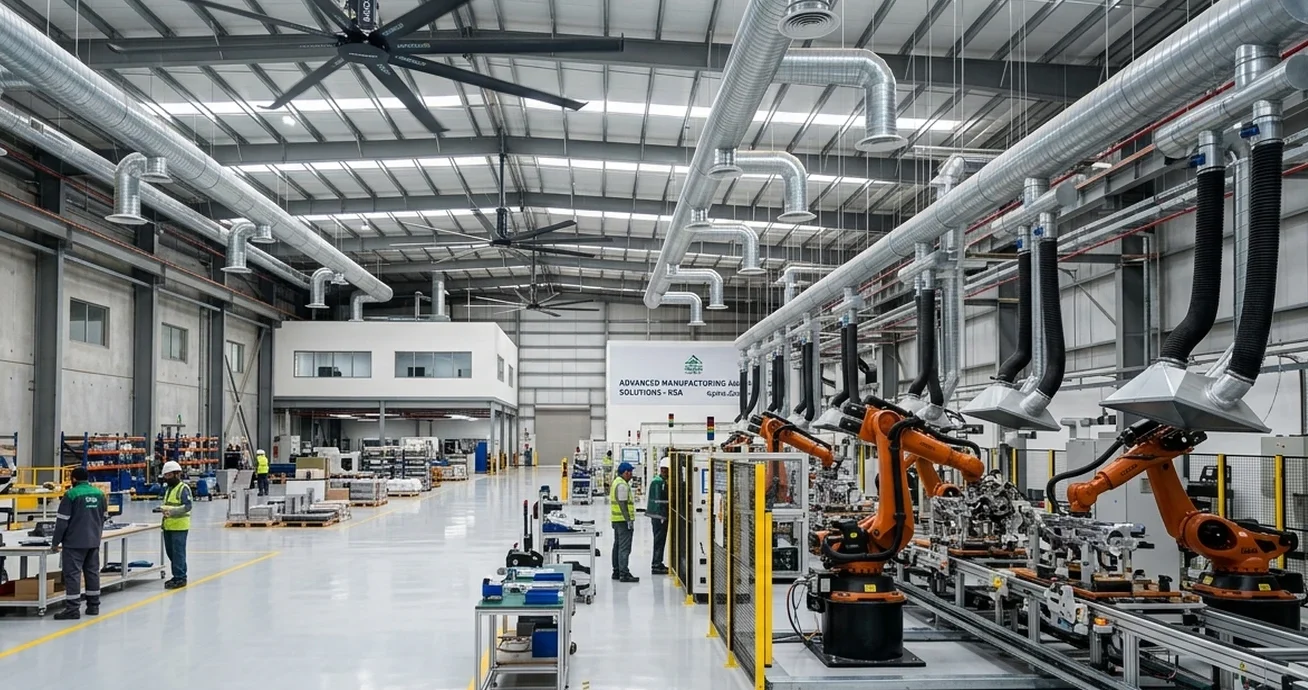
Capturing thermal plumes and fumes directly at the process requires up to 75% less air volume than full-hall dilution.
Eliminates strong negative building pressure that pulls unconditioned 50°C dusty ambient air through loading bays.
Electrical demand reduction achieved compared to traditional DX mechanical compressors in high-bay halls.
Mitigating MENA regional peak electrical grid demand by decoupling industrial comfort from pure refrigeration.
A Saudi factory combines multiple severe thermal and aerodynamic loads. Intense solar radiation penetrates metal roofs and uninsulated facades. Heavy industrial machinery, curing ovens, boilers, and electric motors dump massive sensible heat into the plant. Meanwhile, welding, cutting, grinding, chemical dipping, and powder coating release hazardous fumes, toxic vapours, and respirable dust.
When factory management addresses these issues simply by punching holes in the roof and installing uncoordinated exhaust fans, the facility enters a vicious operational cycle:
Roof exhausters pull severe negative pressure; personnel doors slam violently or become impossible to pull open, creating safety hazards.
Negative pressure pulls unconditioned desert dust and hot ambient air through truck bays, contaminating clean packaging and assembly lines.
Attempting to cool a 12-meter high manufacturing volume with standard DX chillers, resulting in exorbitant utility bills and poor worker comfort.
Supply diffusers blowing directly across exhaust hoods, dispersing toxic fumes across the factory floor instead of capturing them.
Extracting 50,000 m³/h without planned replacement does not make air disappear. The building violently pulls replacement air through every door, loading bay, and wall crack. In Saudi Arabia, that replacement air is 48°C ambient air carrying desert dust directly onto sensitive manufacturing equipment.
The foundational rule of industrial ventilation engineering is: capture contaminants at the generation point before they disperse into the building volume. Once welding fumes, solvent vapours, or furnace heat escape into a 100,000 m³ production hall, removing them requires massive dilution airflow rates and enormous fan power.
Local Exhaust Ventilation (LEV) relies on engineered capture velocity:
• Enclosing Hoods: Glove boxes, fume enclosures, or paint booths that contain contaminants entirely.
• Receiving Hoods: Canopy hoods positioned directly above hot thermal plumes to capture rising heat and smoke via natural buoyancy.
• Capturing Hoods: Slotted backdraft hoods or flexible extraction arms engineered with sufficient face velocity (typically 0.5 to 1.5 m/s) to overcome ambient cross-drafts.
General ventilation remains necessary for background building heat and occupant fresh air (complying with ASHRAE Standard 62.1-2025). However, supply diffusers must be positioned so they do not disrupt the capture envelope of local exhaust hoods. Discover Windmason’s complete range of heavy-duty industrial fans and factory ventilation systems.
For every cubic meter of air exhausted from a factory, an identical volume of replacement air must enter. The difference between an amateur setup and an engineered facility is whether that makeup air enters deliberately through controlled, filtered systems, or accidentally through loading docks and wall gaps.
Engineered makeup air establishes intentional directional pressurization:
1. Controlled Pressurization Cascades: Clean packaging, electronics assembly, or pharmaceutical formulation rooms are maintained under positive pressure relative to adjacent welding, machining, or chemical processing areas, preventing cross-contamination.
2. Tempered & Filtered Delivery: Rather than pulling raw, dusty outdoor air, a dedicated Air Handling Unit (AHU) or Fresh Air Handling Unit (FAHU) filters particulates (MERV 8/13) and tempers the supply air before delivering it directly to worker occupied zones. Learn more about Windmason’s certified Air Handling Units and FAHUs.
High-bay industrial plants typically have ceiling heights ranging from 8 to 14 meters, but human workers occupy only the bottom 2 meters. Treating the entire vertical volume as a single refrigerated box requires massive chiller capacity, exorbitant electrical infrastructure, and high operational expenditure.
High-performance industrial thermal design leverages vertical thermal stratification and microclimate zoning:
Hot process plumes naturally rise toward high-bay ceilings. Roof exhaust louvers extract this stratified heat, while supply systems introduce tempered air low in the occupied zone (displacement ventilation or spot cooling diffusers). Pairing supply air with High-Volume Low-Speed (HVLS) ceiling fans creates gentle air movement (0.8 to 1.2 m/s), producing a natural evaporative cooling effect of 3°C to 5°C on human skin without mechanical refrigeration.
In dry inland Saudi industrial cities like Riyadh, Sudair, and Qassim, Indirect/Direct Evaporative Cooling (IDEC) provides substantial relief. Systems like Supercool 2-Stage IDEC cool fresh outdoor air through a two-stage heat exchanger, dropping dry-bulb temperatures by 15°C to 18°C while drawing up to 70% less electricity than conventional DX air conditioners. Explore our comparison of IDEC versus traditional AC units.
Desert sandstorms and industrial processing create heavy airborne dust loads. A cooling coil clogged with a 2-millimeter layer of industrial dust suffers an 18% loss in heat transfer efficiency and dramatically increases fan static resistance. Rather than replacing filters on rigid calendar intervals, industrial air systems should monitor real-time differential pressure (ΔP), replacing filter media based on actual aerodynamic loading.
Running general exhaust and supply fans at 100% full capacity during shift changes, line retooling, or nighttime maintenance burns excessive power. Variable Frequency Drives (VFDs) paired with process interlocks, temperature sensors, or CO/VOC air quality monitors allow fans to modulate airflow to match real-time production loads.
With smart HVAC energy controls, facilities can implement predictive fan staging and automated fault detection, ensuring equipment operates strictly when needed while protecting safety minimums.
Evaluating common factory ventilation approaches against contaminant capture, building pressure, and operational lifecycle costs:
| Ventilation Strategy | Heat & Fume Control | Building Pressure Impact | Energy Footprint | Capital & OpEx Cost | Saudi Industrial Suitability |
|---|---|---|---|---|---|
| Roof Exhaust Fans Only (No Makeup) | Poor — Recirculates fumes across plant | Severe Negative Pressure (Door slamming, dust suction) | Low CapEx / Hidden High OpEx | Low initial cost / High long-term damage | Unviable for precision manufacturing; pulls peak outdoor heat & dust. |
| Total Volume DX Air Conditioning | Moderate — Dilutes rather than captures | Neutral to Positive (if balanced) | Extremely High (Continuous peak compressor load) | Very High CapEx & OpEx | Economically unsustainable for high-bay uninsulated industrial sheds. |
| Spot Cooling + HVLS Air Movement | Good — Focuses on worker occupied zones | Controlled (Depends on makeup air) | Low to Moderate (Targeted delivery) | Moderate CapEx / Low OpEx | Highly effective for large warehouses, assembly bays, and logistics halls. |
| Engineered Source Capture + IDEC / FAHU Makeup | Superior — Removes contaminants at source | Balanced & Intentional Cascades | Optimized (Up to 70% lower energy than DX) | Balanced CapEx / Rapid 2-year ROI | The gold standard for Saudi manufacturing, fabrication, and chemical plants. |
A rigorous factory ventilation retrofit or greenfield design progresses through seven disciplined engineering milestones:
Identify every welding bay, dip tank, furnace, and cutting station by operating schedule and contaminant release rate.
Establish target occupational exposure limits (OELs) and thermal comfort thresholds for each distinct plant zone.
Size capture hoods, slot velocities, and duct transport velocities (typically 10–20 m/s) to prevent particulate settling.
Determine remaining building sensible heat gains (solar, transmission, lighting) and calculate required air changes.
Define intentional pressure deltas across plant partitions, ensuring clean assembly zones operate positive to dirty process areas.
Evaluate IDEC, evaporative pre-cooling, or dedicated FAHUs based on local design wet-bulb conditions.
Perform Testing, Adjusting & Balancing (TAB) with smoke tests and airflow measurements under representative production modes.
The first step is conducting an on-site aerodynamic and thermal assessment. Rather than immediately buying more roof exhausters or air conditioners, measure actual airflow rates, static pressures, and temperature differentials. Separate process heat and fume sources from building solar envelope gains. Identifying the root cause ensures you solve the problem with targeted source capture and makeup air instead of wasting capital on oversized fans.
In many Saudi industrial regions—particularly inland zones like Riyadh, Sudair, and Qassim where summer relative humidity is low—Indirect/Direct Evaporative Cooling (IDEC) or two-stage evaporative systems can provide significant comfort cooling while using 60% to 75% less electricity than mechanical DX compressors. However, suitability depends on process humidity limits, dust filtration requirements, and water supply availability.
This is a classic sign of severe negative building pressure caused by running exhaust fans without dedicated makeup air systems. The building acts like a giant vacuum, pulling replacement air through whatever cracks it can find. Installing balanced makeup air units restores neutral or slightly positive pressure, eliminating door-slamming hazards and stopping outdoor dust suction.
Safety-critical source exhaust hoods must maintain required capture velocities whenever production machinery operates. However, general factory ventilation, warehouse dilution fans, and makeup air systems can frequently utilize Variable Frequency Drives (VFDs) and smart controls to modulate airflow based on production shifts, indoor temperature, or air quality sensors, saving substantial fan energy.
Industrial Ventilation & Factory Air Management Specialists | Saudi Arabia
Specializing in heavy industrial exhaust ventilation, local source capture systems, dedicated makeup air units (FAHU/AHU), two-stage evaporative cooling (IDEC), and plant airflow balancing across industrial cities throughout Saudi Arabia.
Windmason Arabia conducts industrial ventilation audits, airflow balancing, source capture design, and makeup air system sizing tailored to Saudi Arabia’s severe climate and industrial operations.