
HVAC Peak Demand Reduction in Saudi Arabia: A Practical Guide
How Saudi commercial and industrial facilities can reduce afternoon peak cooling kW through envelope inspection, IDEC pre-cooling, hybrid cooling sequences, and ASHRAE-guided smart BMS automation.

takeaway
The International Energy Agency (IEA) reports that space cooling accounts for about 10% of global annual electricity use but roughly 30% of peak electricity demand. In the Middle East, electricity demand is projected to grow 50% by 2035, with cooling and desalination driving 40% of the surge.
For Saudi facility executives, HVAC systems can no longer be assessed only by annual kWh. Cooling must be engineered and controlled around peak kW, part-load efficiency, fresh-air duty, water use, and verified measurement.
Why peak demand deserves its own engineering target
HVAC peak demand reduction in Saudi Arabia is rapidly evolving from an energy-saving bonus into a core design requirement. Cooling plants face their highest thermal lift during the exact afternoon hours when utility grid stress peaks. A facility may operate with reasonable average annual energy and still generate punishing peak electricity bills because chillers, DX compressors, pumps and fans run simultaneously at maximum power.
Annual energy (kWh) records consumption over time, but peak demand (kW) measures the rate of energy draw. Shaving peak demand reduces demand charges, eases transformer loading, and increases facility power headroom.
Start with the real Saudi cooling load & envelope
Every successful peak-reduction programme begins with passive envelope and internal heat-gain mitigation. Saudi climates vary markedly: Riyadh's extreme dry bulb (48°C–50°C) demands heavy sensible lift, while coastal Jeddah and Dammam require intensive moisture removal.
A 2025 simulation study in Buildings showed that insulated ceilings and reduced window-to-wall ratios substantially cut peak loads, while high-performance glazing reduces cooling loads by 5–7%. Every kilowatt of solar heat kept out of the building is a kilowatt the mechanical plant avoids compressing.
Match the cooling architecture to climate and duty
Modern commercial and industrial buildings rarely rely on a single cooling mechanism. The most resilient facilities employ a staged hybrid of high-efficiency DX, VRF, chilled water, indirect-direct evaporative cooling (IDEC), and dedicated outdoor air treatment (FAHU / DOAS).
In hot-dry conditions, IDEC achieves significant temperature reduction using only fan and water pump power, bypassing compressor work entirely. When handling fresh-air duty, IDEC pre-cools outdoor air prior to DX coil entry, slashing compressor peak load by up to 60%.
Control sequences determine real operating performance
Advanced hardware is only as effective as the sequence of operations controlling it. ASHRAE Guideline 36-2024 (High-Performance Sequences) and ASHRAE Guideline 13-2024 (Specifying BAS) define standardized logic that prevents equipment hunting and simultaneous heating/cooling.
- Calibrated enthalpy sensors, flow meters and calculated psychrometric points
- Automated equipment rotation and staged compressor threshold enable logic
- Dynamic chilled water temperature and static pressure reset algorithms
- Deadband enforcement to prevent simultaneous mechanical heating and cooling
- 15-minute trend logging with automated fault detection and diagnostic (FDD) alerts
A 2026 U.S. Department of Energy project validated 12-hour predictive temperature forecasting using model-predictive controls (MPC). In Saudi applications, smart controls should adapt setpoints dynamically while respecting hardware safety interlocks.
Do not trade indoor environmental quality for lower demand
Peak reduction strategies fail if they lead to stuffy rooms, elevated CO&sub2;, or dust infiltration. A June 2026 review in Sustainability showed smart ventilation can reduce HVAC energy by up to 60%, but stressed the importance of proper sensor maintenance and multi-stage filtration.
Never reduce fresh-air rates below ASHRAE Standard 62.1 minimums simply to shave peak kilowatts. Instead, deploy Demand-Controlled Ventilation (DCV), multi-stage particulate filtration (MERV 13+), and Energy Recovery Ventilation (ERV).
A practical 6-step HVAC peak-demand reduction plan
Execute this 6-step engineering roadmap to achieve verifiable peak-demand reduction across commercial and industrial facilities:
-
01Establish the Baseline Collect sub-metered electrical demand, energy, weather, operating hours and indoor conditions. Identify the specific equipment combinations driving peak kW.
-
02Correct Mechanical & Sensor Faults Clean fouled coils, replace loaded filters, calibrate temperature/enthalpy sensors, and remove manual BMS overrides before deploying optimization logic.
-
03Reduce & Reshape the Cooling Load Seal envelope leaks, reset supply temperatures dynamically, align equipment schedules with occupancy, and pre-cool building thermal mass at night.
-
04Compare System Options Hourly Evaluate IDEC, VRF, and hybrid options against 8,760 hourly psychrometric weather data rather than a single peak summer temperature point.
-
05Commission the Sequences Execute rigorous functional testing across all staging modes and alarm states. Verify trend logging and train on-site facility operators.
-
06Verify with IPMVP M&V Protocols Compare normalized post-installation data with the baseline, adjusting for weather and occupancy. Always report annual kWh and peak kW separately.
What this means for Saudi projects
The regional power outlook favors HVAC designs that lower peaks and use electricity intelligently. Yet credible decarbonization begins with measured load, suitable equipment and functioning controls. Connected dashboards are useful only when the sensors, sequences and response actions are dependable.
Windmason Arabia assists facility leaders in assessing local climate data, fresh-air requirements, hourly load profiles, hybrid cooling architectures, BMS integration, and commissioning protocols as one unified system.
Frequently asked questions
Latest Published Insights
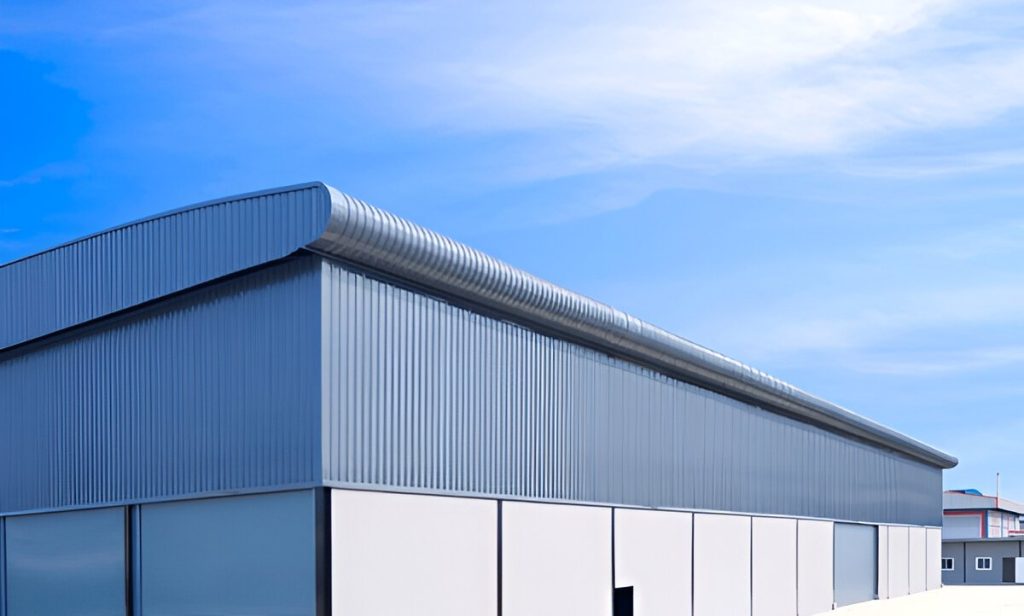
Warehouse Cooling in Saudi Arabia
Struggling with warehouse heat and high AC bills? Learn how Saudi warehouses can use smarter airflow, IDEC and...
›Read Article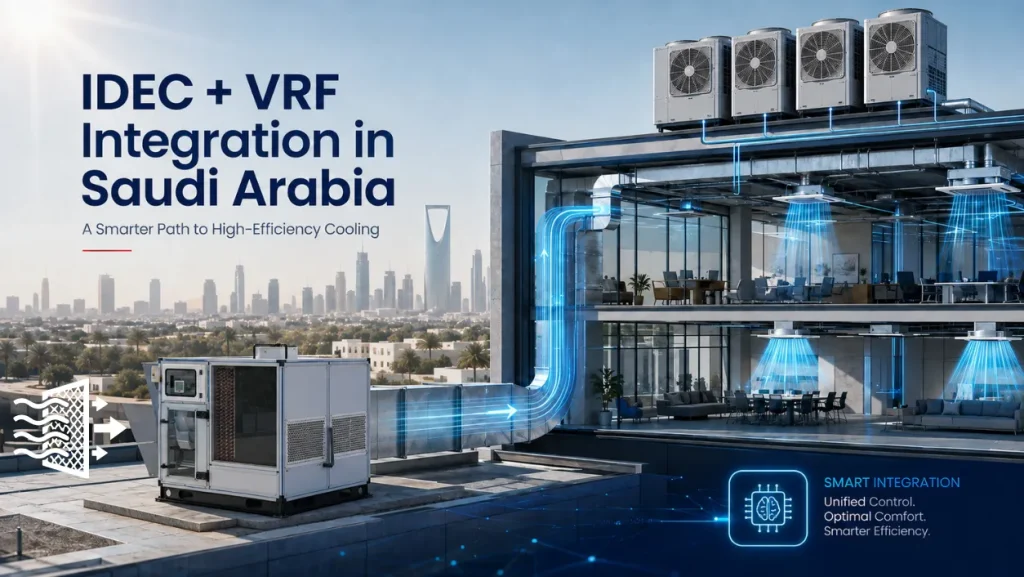
IDEC + VRF Integration : Smarter High-Efficiency Cooling
Discover how IDEC, VRF and intelligent HVAC controls can work together to reduce cooling loads, improve IAQ and...
›Read Article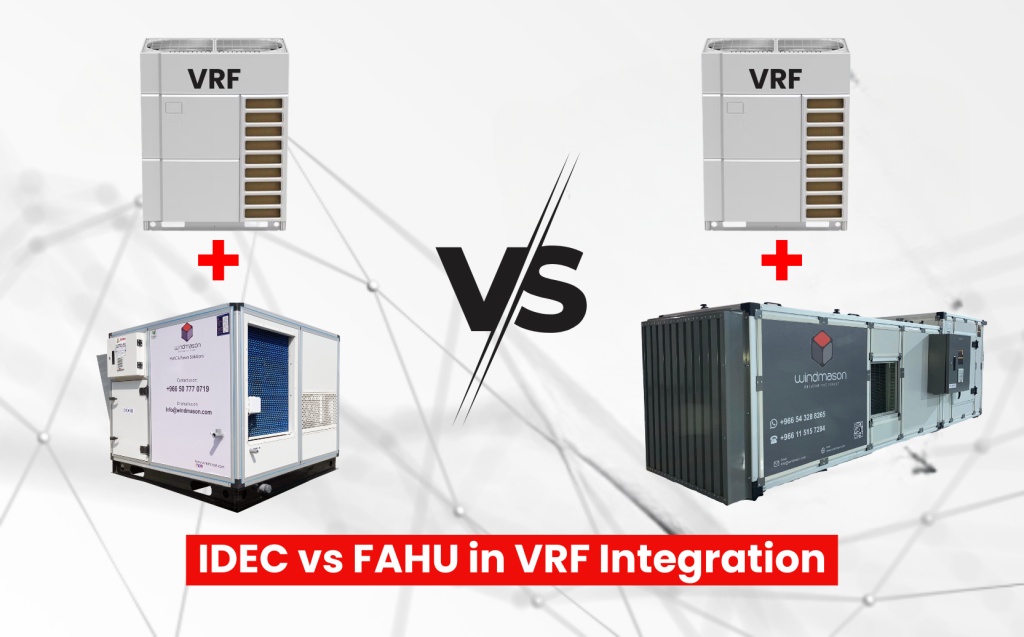
IDEC vs FAHU in VRF Integration
IDEC vs FAHU in VRF Integration: How Windmason IDEC Redefines Energy-Efficient HVAC Solutions in Saudi Arabia and Middle...
›Read Article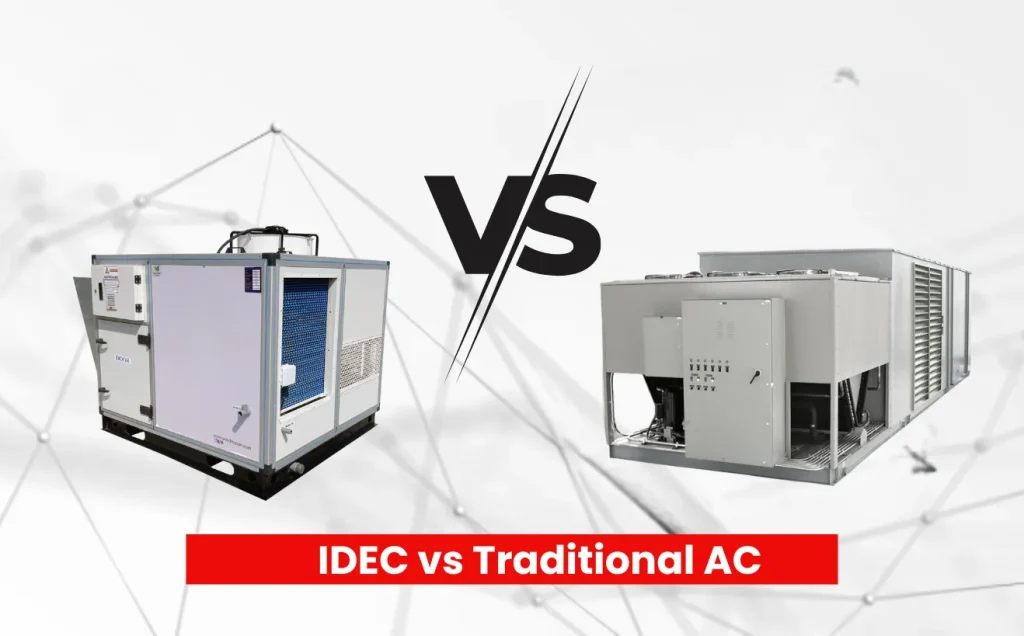
IDEC vs Traditional AC Units: Key Differences
Compare IDEC indirect-direct evaporative cooling with traditional air conditioners. Learn how IDEC vs Traditional AC Units differ in...
›Read Article
IDEC a Sustainable Cooling Solution
Let’s explore how Indirect Direct Evaporative Cooling (IDEC) can revolutionize climate control by offering an energy-efficient solution.
›Read Article
Windmason Arabia Partners with EcoEdgeAI
Learn more about energy efficiency and cooling solutions in Saudi Arabia.
›Read Article