“We need more fresh air” sounds like a simple HVAC request. In Saudi Arabia, it is not simple, outdoor air can arrive extremely hot, humid in coastal cities, dusty during poor-air-quality events, and expensive to cool if the ventilation system is poorly designed.
At the same time, reducing ventilation just to save energy can create stale spaces, odor complaints, high CO₂ in occupied rooms and poor indoor environmental quality (IEQ).
The goal is not “maximum fresh air.” The goal is the right air, at the right quantity, at the right condition, at the right time. That requires treating fresh air ventilation as an engineered system of airflow quantity, filtration, cooling load, humidity control and building automation.
Facility managers often see ventilation problems as unrelated complaints: occupants report that conference rooms feel stuffy by mid-afternoon, fine sand settles on surfaces after dust events, or electrical bills spike whenever the outdoor-air damper is opened.
These symptoms point to a single system-level issue. Ventilation quantity, filtration, outdoor-air pre-cooling and controls are operating as disconnected pieces rather than a coordinated ventilation strategy.
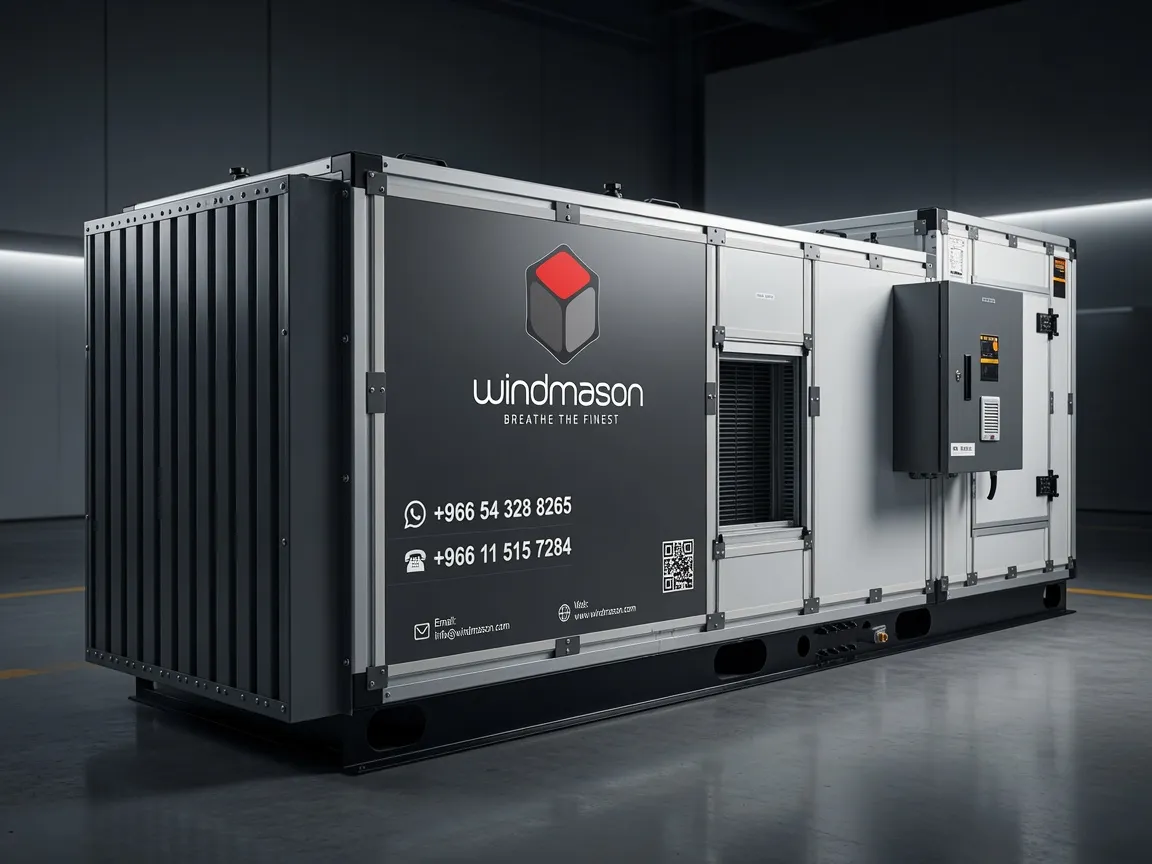
Windmason’s AHU and FAHU solutions provide product context for filtered fresh-air treatment in Saudi facilities, while this guide covers the underlying engineering principles.
Ventilation dilutes contaminants generated indoors. That is one of its core purposes. People exhale carbon dioxide, office furniture and finishes emit volatile organic compounds (VOCs), and indoor activities create moisture and odors.
ANSI/ASHRAE Standard 62.1-2025 defines minimum ventilation rates and other measures intended to provide acceptable indoor air quality in commercial and institutional spaces. For enhanced air cleaning beyond minimum code, ASHRAE Guideline 42-2023 provides design and operational guidance.
But outdoor air itself can contain particulate matter, dust or other pollutants. A 2025 Building and Environment study on real-world IAQ monitoring emphasizes that outside-air quality must be accounted for when determining ventilation strategies.
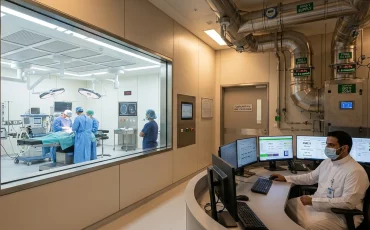
“100% fresh air” means the ventilation unit introduces only outdoor air without recirculating indoor air through that specific unit. This approach is common in hospitals, laboratories and certain commercial kitchens. However, for most commercial buildings, 100% fresh air across the entire HVAC plant creates an extreme cooling load unless equipped with dedicated pre-cooling and heat recovery.
Every cubic metre of hot outdoor air brought into a cooled building carries sensible heat. If that air arrives at 45°C and must be supplied at 14°C, cooling coils must remove 31°C of temperature difference before addressing any internal heat gains from people, lighting and equipment.
In coastal cities like Jeddah, Dammam and Khobar, outdoor air also carries a large latent load (moisture). The ventilation coil must condense kilograms of water per hour, requiring low coil surface temperatures and reheat if spaces are not to become cold and clammy.
The ventilation strategy must therefore be based on local psychrometric data and building operating profiles rather than standard catalogue rules of thumb.
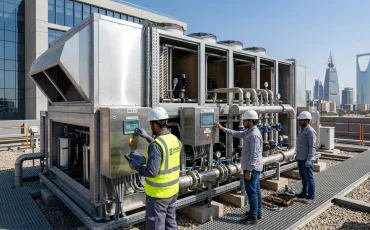
A Dedicated Outdoor Air System (DOAS) or Fresh Air Handling Unit (FAHU) treats ventilation air centrally, filtering and conditioning it before delivering it to zones, while separate terminal units (FCUs, VRF indoor units, or VAV boxes) handle the internal thermal loads.
This separation makes commissioning and temperature control much simpler: the central FAHU guarantees that outdoor air meets filtration and humidity requirements, while zone units respond solely to thermostat demand without being destabilized by sudden rushes of outside air.
The concept is especially valuable in Saudi commercial buildings where occupancy varies between meeting rooms, offices, auditoriums and prayer halls.
Hot, dry outdoor air creates a large sensible load — but in Riyadh and other arid regions of Saudi Arabia, it also creates ideal conditions for indirect-direct evaporative cooling (IDEC).
For a Saudi fresh-air system, the benefit is dramatic: pre-cool outdoor air using evaporative stages before it reaches the mechanical DX or chilled-water cooling coil. In favorable weather, IDEC can drop incoming 45°C air down to 22°C–25°C purely through indirect heat exchange without adding moisture to the supply airstream with 100% fresh air.
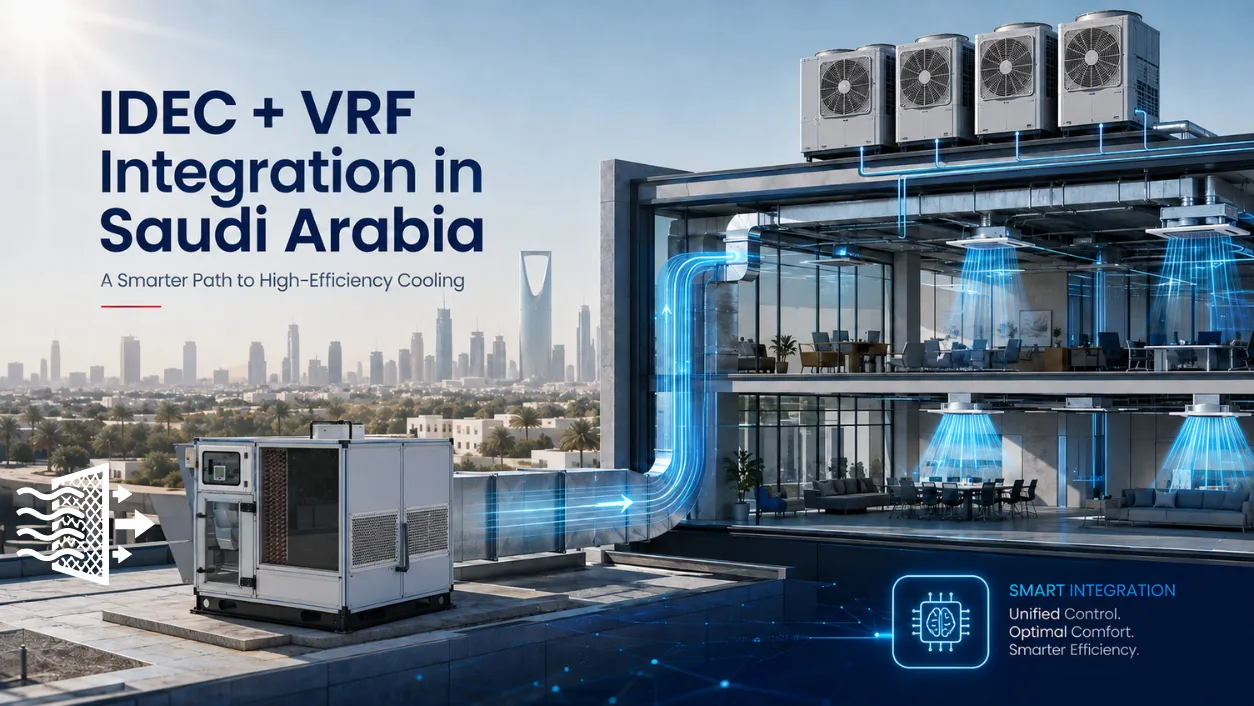
Pre-cooling outdoor air centrally before distribution protects downstream equipment from thermal shock, reduces the required refrigeration capacity of the building by 30% to 50%, and ensures consistent supply air temperatures.
ASHRAE Standard 52.2 provides a standard method for testing general-ventilation air cleaners by particle size. But in Saudi Arabia’s dust-heavy atmosphere, a filter rating on a specification sheet does not guarantee clean indoor air.
A highly rated filter performs poorly if air bypasses around the frame through gaps. A filter that clogs prematurely causes fan power to surge or airflow to drop below code minimums. Effective filtration requires a staged system designed for Saudi conditions:
Captures heavy dust and coarse sand particles before they load higher-efficiency downstream media.
Removes fine atmospheric particulates and PM2.5, meeting ASHRAE 62.1-2025 and LEED IEQ standards.
Continuous gasketed sealing to prevent dirty air bypass around filter tracks, which can ruin filtration efficiency.
Magnehelic gauges or digital DP sensors across every bank to alert maintenance teams when replacement is actually needed.
Carbon dioxide (CO₂) is widely used as a proxy for occupancy-related ventilation because people produce CO₂ proportionally to their metabolic rate. When indoor CO₂ rises above 1,000–1,200 ppm, occupants often report drowsiness and difficulty concentrating.
However, CO₂ sensors do not detect dust, PM2.5, carbon monoxide, chemical odors, or formaldehyde emitted by building materials. A room can have low CO₂ while still containing hazardous particulate or chemical concentrations.
Traditional ventilation systems deliver fixed outdoor-air airflow from morning to night, regardless of whether a hall holds 200 people or 5 people. In Saudi Arabia’s extreme climate, cooling unneeded outside air across empty spaces is pure financial waste.
A recent review by Rizo-Maestre et al. (2025/2026) on smart ventilation emphasizes that significant energy savings are achievable without sacrificing IAQ, provided sensor calibration and control sequences are properly commissioned.
Demand-Controlled Ventilation (DCV) uses CO₂ sensors, occupancy schedules, and VAV dampers to dynamically modulate fresh air supply. When rooms are empty, outdoor airflow drops to the building base rate; when occupancy increases, dampers open smoothly to maintain pristine air quality.
Indoor air quality is only one component of Indoor Environmental Quality (IEQ). A building with clean air can still produce occupant dissatisfaction if thermal comfort, acoustic noise or lighting are neglected.
If occupants complain about stuffy air or the facility owner believes fresh air is driving excessive electrical bills, start with this structured 6-step engineering audit:
Saudi buildings do not need to choose between stale indoor air and catastrophic cooling utility bills. The solution lies in engineering control:
The required quantity depends on occupancy type, floor area, specific activities, and the applicable code standard. ANSI/ASHRAE Standard 62.1-2025 provides rate procedures combining per-person and per-floor-area ventilation rates. A ventilation audit calculates exact baseline requirements for each zone.
Not automatically. If outdoor air contains high concentrations of dust, particulate matter (PM2.5), or excessive humidity, increasing outside air without adequate multi-stage filtration and moisture removal can actually degrade indoor environmental quality.
Indirect-direct evaporative cooling (IDEC) is extraordinarily effective in dry, hot-arid climates such as Riyadh, Qassim, and Madinah where wet-bulb depressions are large. In coastal cities like Jeddah and Dammam, high ambient humidity limits evaporative cooling potential, requiring dedicated mechanical or desiccant dehumidification.
An Air Handling Unit (AHU) typically conditions a mix of recirculated return air and outdoor air for zone cooling. A Fresh Air Handling Unit (FAHU) or Dedicated Outdoor Air System (DOAS) treats 100% outside air centrally—filtering, pre-cooling, and dehumidifying it—before delivering it into the building.
CO₂ sensors indicate real-time human occupancy. Through Demand-Controlled Ventilation (DCV), the automation system modulates fresh air dampers so the system only conditions the airflow needed for actual occupants rather than cooling continuous design-capacity outdoor air across empty rooms.
Summary: Establishes minimum ventilation rates and measures intended to provide acceptable IAQ in commercial spaces. The 2025 edition clarifies humidity-control baselines, air-density altitude adjustments, and demand-controlled ventilation sequences.
Summary: Recommends measures that exceed minimum baseline standards to achieve enhanced IAQ, covering advanced particulate filtration, commissioning, gaseous air cleaning, and continuous monitoring.
Summary: Defines laboratory testing of general-ventilation air cleaners for particle-size removal efficiency (MERV ratings across E1, E2, E3 size ranges).
Summary: Reviews smart ventilation strategies and demonstrates that intelligent airflow control can cut building ventilation energy by 20% to 45% while preserving superior indoor environmental quality.
Summary: Real-world field monitoring demonstrating how outdoor dust and pollution episodes directly impact indoor air unless outdoor-air treatment is actively modulated.