
Why commercial and residential facilities in coastal Saudi Arabia feel damp at 23°C, how latent moisture and dew points govern Red Sea psychrometrics, and how engineered ventilation, DOAS decoupling, and coil staging permanently prevent diffuser sweating and mold.
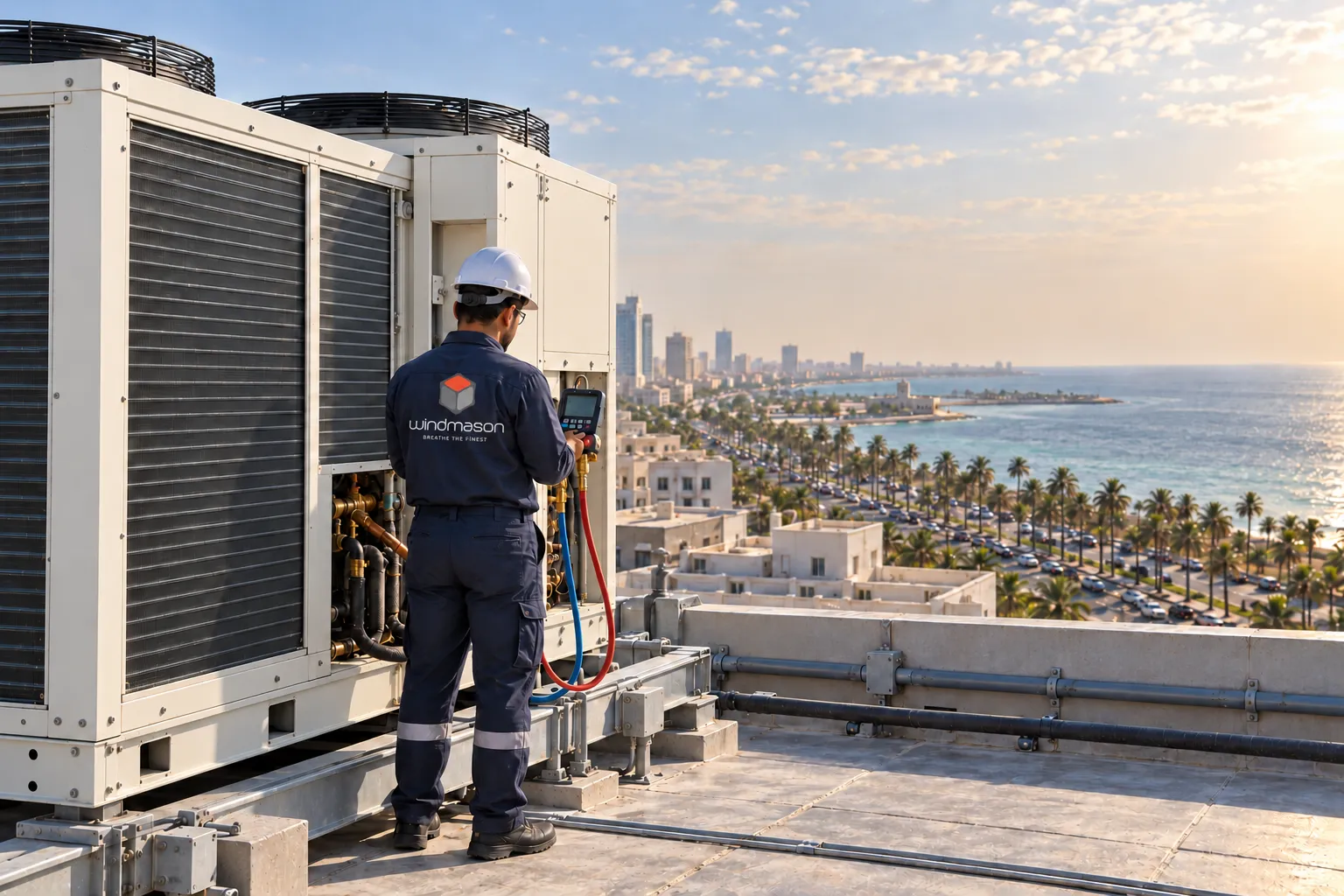
The thermostat says 23°C. The air conditioner is running. Yet the room still feels sticky, the glass sometimes sweats, a musty smell returns, and occupants keep asking for a lower setpoint. In coastal Jeddah, cooling the air (sensible cooling) and drying the air (latent dehumidification) are related but fundamentally different engineering jobs.
A conventional cooling system satisfies the thermostat while leaving excessive moisture in the building. Lowering setpoints further wastes energy and accelerates diffuser sweating. Effective HVAC humidity control in Jeddah requires decoupled ventilation air treatment (DOAS), dew-point-based staging, envelope pressurization, and psychrometrically matched cooling equipment.
For site measurement, psychrometric audits, and corrective engineering, consult Windmason's HVAC services or technical contact team. Humidity-control architectures can be coordinated with Windmason's AHU and FAHU systems and three-stage IDEC systems.
HVAC humidity control Jeddah projects must manage dew point, outdoor air, and infiltration alongside room temperature.
An air conditioner removes two types of load:
Sensible cooling reduces air temperature. Latent cooling removes water vapor from the air, normally by cooling air below its dew point so moisture condenses on a cooling coil.
A thermostat primarily sees sensible temperature. It may therefore tell the cooling system to reduce capacity once the room reaches its temperature setpoint even though indoor humidity is still high.
This is particularly important in coastal Saudi Arabia because outdoor ventilation and infiltration continuously bring moisture into the building.
The symptoms are often visible before anyone uses the words “latent load”:
Saudi Arabia cannot be represented by one summer design condition.
Riyadh commonly experiences very high dry-bulb temperatures with relatively dry air. Jeddah is strongly influenced by the Red Sea and can experience much higher moisture levels. KAPSARC even publishes humidity-adjusted cooling-degree-day data for Saudi regions because humidity changes the energy and comfort picture.
This difference affects the usefulness of evaporative processes, the size of the latent load and the amount of moisture entering with outdoor air.
A Building and Environment study by Baakeem and colleagues examined dew-point/M-Cycle evaporative cooling in Arabian Gulf climates, including Jeddah. One important lesson from the work is not a universal humidity cut-off, but that feasibility changes materially with local psychrometric conditions.
That is why a Riyadh system should never be copied into Jeddah using only the same dry-bulb temperature and tonnage.
Relative humidity is useful, but dew point often tells the building engineer more about condensation risk.
The dew-point temperature is the temperature at which air becomes saturated and water begins to condense. If a surface—such as an uninsulated duct, chilled pipe, diffuser neck or glazing zone—is colder than the dew point of the surrounding air, condensation can occur.
For example, lowering supply-air temperature may make a metal diffuser colder. If indoor moisture remains high, the surface can cross the dew point and begin to sweat.
The solution is not necessarily to warm the entire building. It is to control the moisture source, maintain the correct coil/dehumidification process, insulate cold surfaces where required and prevent uncontrolled humid-air infiltration.
Every occupied commercial building needs an appropriate ventilation air strategy. But in Jeddah, outside air can carry a significant moisture load.
If ventilation air is introduced without adequate conditioning, the zone-level AC system must remove both its sensible heat and its moisture. If doors, pressure imbalances and leakage add more humid air, the real latent load may be much larger than the design expected.
This can lead to a common failure: the room AC reaches temperature quickly, reduces output, and leaves the ventilation moisture behind.
A better design deliberately treats outdoor air rather than allowing it to arrive as an uncontrolled penalty.
Dedicated outdoor-air concepts (DOAS / FAHU) separate ventilation-air treatment from zone sensible cooling.
The outdoor-air unit can filter, cool and dehumidify the ventilation air to a defined condition. VRF fan coils, chilled-water terminals or other zone systems can then respond mainly to space loads.
This separation can make control clearer. The ventilation system is responsible for outdoor-air quantity and moisture management; the zone system is responsible for individual space temperature.
It also avoids asking a small zone terminal to fix a humidity problem created elsewhere in the air system.
The correct arrangement still depends on occupancy, pressure, exhaust, envelope leakage and project requirements.
It can, but the word “evaporative” needs careful engineering in a humidity-control article.
Direct evaporative cooling adds water vapor to the product airstream. That can be very useful in dry climates but may be undesirable when the customer is already fighting excess moisture.
Indirect evaporative cooling is different: the product air and wetted working air are separated by a heat exchanger. This allows sensible pre-cooling without directly adding moisture to the product air.
Recent research continues to examine indirect evaporative cooling in hybrid arrangements with mechanical refrigeration and variable-refrigerant systems (IDEC + VRF integration). The potential value is to reduce sensible temperature before the compressor stage while allowing the mechanical coil to deliver the final temperature and latent control.
Additional product context is available for four-stage Supercool IDEC and the guide to IDEC and FAHU integration with VRF.
However, even indirect-system benefit reduces as outdoor wet-bulb/dew-point conditions become less favorable. A Jeddah design therefore needs an operating map: when should indirect cooling contribute, when should it be bypassed, and when must DX/VRF dehumidification dominate?
“Bigger is safer” is not always true for comfort cooling.
An oversized unit may pull the room temperature down quickly and then cycle off. Short runtime can reduce the amount of moisture condensed at the cooling coil. The space becomes cool before it becomes dry.
Other causes of poor latent performance can include excessive airflow across the coil, incorrect refrigerant charge, dirty heat-transfer surfaces, failed controls, poor drainage, inappropriate supply-air temperature, or a ventilation load beyond the system’s design.
Before buying additional tonnage, the owner should investigate why the existing equipment is not controlling moisture.
Facility managers, building owners, and MEP consultants facing persistent clamminess or sweating diffusers should execute this structured 5-step engineering roadmap:
Selecting equipment for coastal Jeddah requires evaluating how different mechanical designs handle extreme latent enthalpy compared to dry inland regions:
| Architecture Strategy | Primary Mechanism | Latent Dehumidification | Diffuser Sweating Risk | Energy Efficiency | Recommended Application |
|---|---|---|---|---|---|
| Constant-Volume DX / Split | Single-stage thermostat on/off cycling | Poor (Cycles Off Early) | High Risk | Low (Short-Cycling) | Inland dry regions; strictly not recommended for coastal Jeddah |
| Standard VAV Air Handling | Modulates CFM to satisfy dry-bulb setpoint | Reduced at Part-Load | Moderate | Medium | Low-occupancy commercial offices with dry fresh air ratios |
| Decoupled DOAS + Zone VRF | 100% fresh air pre-dried to 11°C DP; VRF manages sensible load | Superior (Independent) | Negligible | Very High (Decoupled) | Hotels, retail malls, hospitals, and occupied commercial towers |
| Indirect Evaporative (IDEC) + DX | Indirect sensible pre-cooling isolates product air; DX trims dew point | High (Pre-Cooled Lift) | Low | Maximum Peak Shaving | Logistics warehouses, semi-conditioned workshops, and showrooms |
ASHRAE Standard 62.1-2025 remains focused on ventilation and acceptable indoor air quality, but the 2025 edition also expands humidity-control requirements.
That is a useful reminder for Saudi projects: ventilation, humidity and IAQ cannot be engineered as isolated subjects.
Bringing more outdoor air into a coastal building may improve dilution of indoor contaminants, yet it also creates a moisture load that has to be treated. Reducing outdoor air indiscriminately to “fix humidity” can create an IAQ problem. The design must satisfy both requirements.
A useful report should show evidence, not just a recommendation to replace equipment. Ask for:
With this data, the engineer can identify whether the dominant issue is ventilation moisture, infiltration, coil performance, oversizing, control logic, insulation or a combination.
The most expensive humidity-control strategy is often to keep lowering the temperature while moisture continues to enter unchecked.
Good HVAC humidity control Jeddah design treats temperature and moisture as separate variables. It conditions outdoor air deliberately, protects dew-point-sensitive surfaces, sizes and controls cooling equipment for sensible and latent loads, and uses hybrid technologies only when the psychrometrics support them.
That approach improves comfort without pretending Jeddah behaves like an inland dry climate.
If your Jeddah facility is cool but still feels humid, Windmason Arabia can review the psychrometrics, outdoor-air load, equipment operation and control sequence before recommending additional cooling capacity.
Diagnosis should compare indoor dew point, coil leaving condition, ventilation airflow, room pressure and operating schedules. A lower dry-bulb setpoint can hide the source of moisture while increasing condensation risk on cold surfaces. Trending these variables during occupied and unoccupied periods helps distinguish infiltration, excessive outdoor air, coil performance and control-sequence problems.