The Saudi Arabia refrigerant transition moved from a future policy question to a live planning requirement when the Kigali Amendment entered into force for the Kingdom on 9 December 2025. This matters to owners, consultants, manufacturers, contractors and service teams working with DX units, VRF systems, packaged equipment and chillers.
The change does not mean every HFC system must be replaced immediately. Kigali establishes a national phase-down of hydrofluorocarbon consumption, measured in carbon-dioxide-equivalent terms. Saudi Arabia follows the high-ambient Group 2 schedule: its baseline uses average HFC consumption from 2024 to 2026, the freeze begins in 2028, and the scheduled reduction reaches 85% by 2047.
That timeline gives the industry time to prepare, but it also changes long-life procurement decisions made today. Equipment installed in 2026 may operate well into the phase-down period. The responsible approach is to examine refrigerant availability, safety, energy performance, servicing and replacement risk before issuing a purchase order.
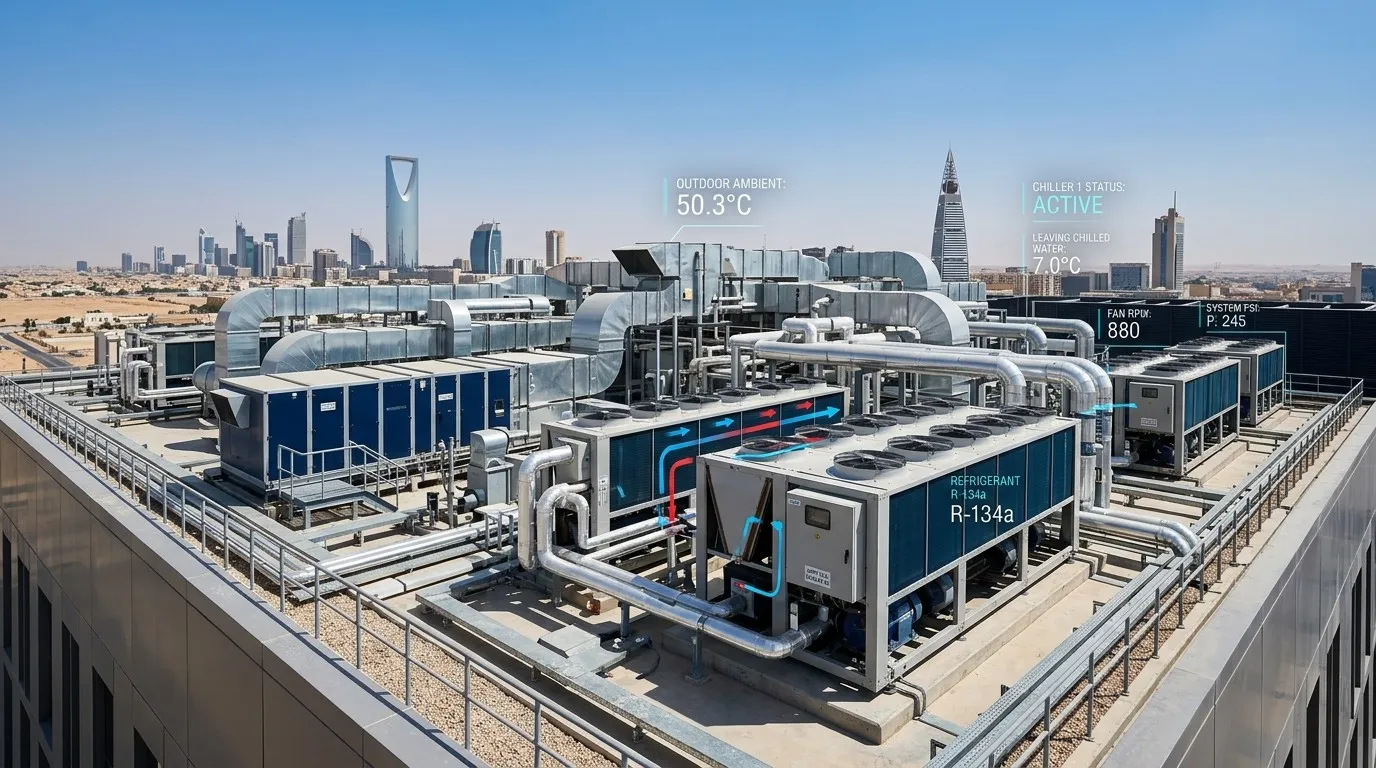
Refrigerant transitions affect more than refrigerant cylinders. Manufacturers may need redesigned heat exchangers, compressors, controls and safety features. Contractors need correct installation tools and procedures. Facility teams need leak records, recovery equipment and qualified technicians. Designers must reconsider charge limits, occupied-space volumes and machinery-room requirements.
The International Institute of Refrigeration summarizes the Saudi schedule as a 2028 HFC freeze followed by staged reductions to 85% below the defined baseline by 2047. A phase-down permits flexibility across the national market. It does not require every application to use the same fluid or move on the same date.
HVAC climate impact comes from direct and indirect emissions. Direct emissions occur when refrigerant escapes during manufacture, installation, operation, servicing or disposal. Indirect emissions come mainly from electricity used to run compressors, fans, pumps and controls.
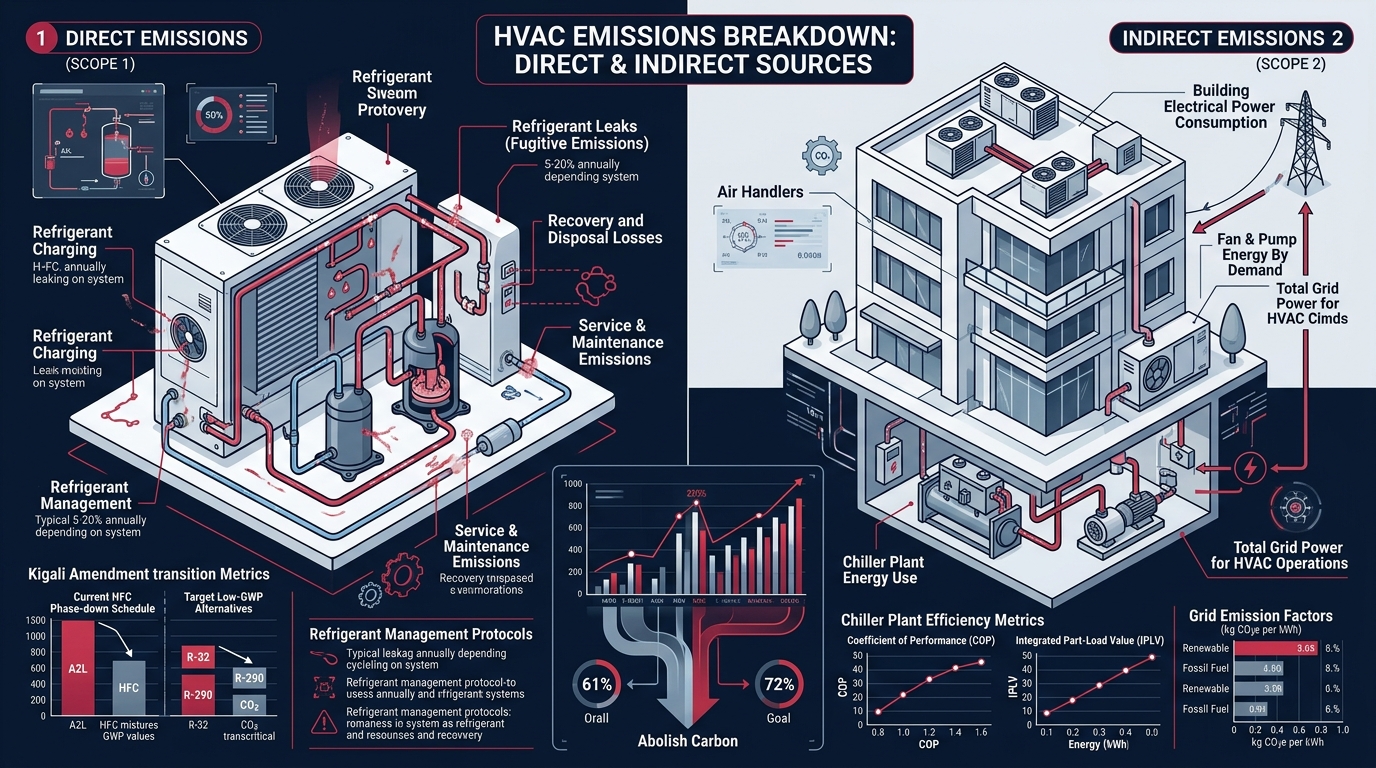
UNEP’s Global Cooling Watch 2025 estimates that cooling demand could more than triple by 2050 under business as usual. Cooling-related emissions could reach 7.2 billion tonnes of CO₂-equivalent in 2050. Its Sustainable Cooling Pathway would cut the expected 2050 level by 64%, while rapid power-sector decarbonization could reduce residual emissions much further.
The practical lesson is that a lower-GWP refrigerant does not excuse inefficient equipment. Likewise, efficient equipment using a high-GWP refrigerant still carries leakage and end-of-life risk. Project comparison should examine both.
A useful assessment includes refrigerant charge, expected leakage, recovery at retirement, annual energy, grid emissions and equipment life. The calculation should also test Saudi outdoor temperatures rather than relying only on standard rating conditions.
Saudi HVAC systems regularly face operating conditions that are harder than moderate-climate catalogue points. As outdoor temperature rises, condensing pressure and compressor work generally increase, capacity may fall and discharge temperature can approach equipment limits.
UNEP’s Kigali decision recognizes this technical issue. Its high-ambient criterion covers countries with at least two months per year, over ten consecutive years, where peak monthly average temperature exceeds 35°C. Saudi Arabia is on the eligible-country list, and the listed equipment includes multi-split, split-ducted and ducted commercial packaged air conditioners.
This provision is not a permanent blanket exemption. It allows defined treatment where suitable alternatives do not exist, subject to notification, reporting and technical review. For engineers, the important point is that low GWP must be paired with proven performance at the actual design temperature.
Actual derated capacity and capacity degradation at 48°C/50°C ambient;
Total efficiency including both indoor and outdoor condenser fan power;
Current, pressure ratio and discharge temperature thermal protection envelope;
Operating-envelope limits and automated control response under peak heat;
Total charge and charge per occupied space volume (ASHRAE 15 compliance);
Safety classification (A1, A2L, A3) and mandatory mitigation requirements;
Local supply, trained technician competence and certified recovery options;
Spare parts availability and manufacturer guaranteed support period.
Many lower-GWP options have different flammability characteristics from the refrigerants they replace. ASHRAE Standard 34 assigns refrigerant safety classifications based on toxicity and flammability data and publishes concentration limits. ASHRAE Standard 15 then addresses safe system design, installation and operation.
The 2024 edition of Standard 34 added 28 refrigerants and burning-velocity data for flammable refrigerants. Standard 15-2024 clarified effective dispersal volume charge calculations, concentration-limit terminology, and provisions for handling, transport and storage of flammable refrigerants.
A label such as A2L is therefore a design input, not a complete safety decision. Requirements depend on charge, room volume, occupancy, equipment construction, location and the adopted code. Possible measures may include charge limitation, leak detection, ventilation, shut-off logic, labelling, restricted ignition sources and service controls. The project team must confirm the rules that Saudi authorities currently apply.
A refrigerant should never be added to equipment merely because pressures appear similar or a supplier calls it a replacement. Compressors, lubricants, seals, heat exchangers, expansion devices, controls and safety certification are designed as a system. A field conversion without written manufacturer approval may reduce capacity, damage equipment, create an unsafe charge or invalidate certification and warranty.
For existing assets, the first action is an inventory. Record equipment model, age, charge, refrigerant, annual leak history, condition, duty, criticality and planned replacement year. This separates systems that can be maintained responsibly from those needing an orderly replacement plan.
A refrigerant-transition-ready tender should require more than a model number. Ask bidders to submit the following:
Designation, ASHRAE safety class, charge and applicable concentration limits.
Capacity, total power and efficiency at the specified Saudi outdoor condition, with the test standard and tolerances identified.
Maximum ambient, compressor limits, control response and derating.
Occupied-space or machinery-room assessment, required detection, ventilation and electrical provisions.
Refrigerant and spare-parts availability, warranty, technician requirements and recommended service tools.
Pressure test, evacuation, charging, detection, logging, recovery and disposal procedures.
Measured airflow, temperatures, pressures, current, alarms and safety interlocks.
Seasonal or hourly performance using local weather and operating schedules.
The Saudi Arabia refrigerant transition also strengthens the case for reducing compressor duty where climate and application permit. Indirect-direct evaporative cooling uses water evaporation and fans to provide cooling without refrigerant in the evaporative stages. In a hybrid arrangement, IDEC can handle suitable hours or pre-cool air before a DX or VRF stage.
This can reduce the mechanical refrigeration capacity or operating hours required, but the result depends on dry-bulb and wet-bulb temperature, airflow, pressure drop, supply condition, water quality and controls. Riyadh and other hot-arid locations may offer strong evaporative potential. Jeddah, Dammam and other humid coastal areas need different stage selection because high wet-bulb temperatures limit evaporative cooling.
This approach can address direct and indirect emissions together, but Windmason should state projected benefits as calculated results and verify them after commissioning.
Good refrigerant management protects supply, cost and climate performance. A maintenance programme should include leak detection, accurate charging, recovery, cylinder identification, contaminated-refrigerant control and service records. Technicians must understand the safety class of every refrigerant they handle.
UNEP’s phase-down decision specifically identifies technician certification, training, servicing tools, refrigerant testing, recovery and recycling as transition activities. These are operational requirements, not secondary environmental paperwork.
Owners should also avoid topping up a leaking system repeatedly without finding the cause. Repair quality, recovered quantity and final charge should be documented. At retirement, refrigerant should be recovered rather than vented.
Saudi Arabia deposited its instrument of acceptance on 10 September 2025. The amendment entered into force for the Kingdom on 9 December 2025.
The 2028 milestone is the Group 2 national consumption freeze, not an automatic ban on every HFC system. Saudi implementing measures and later reduction steps will determine market effects.
No. Selection depends on approved equipment design, high-ambient capacity and efficiency, charge, safety classification, space volume, local rules and service capability.
Only where the original equipment manufacturer provides a documented, approved conversion. Similar operating pressure does not establish compatibility or safety.
The evaporative cooling stages do not use a refrigerant circuit. A hybrid IDEC-DX system still contains refrigerant in its mechanical stage.
Create an equipment and refrigerant register, identify high-leakage or end-of-life assets, and require transition, safety and high-ambient information in new tenders.
The Saudi Arabia refrigerant transition is now part of responsible HVAC planning. The best response is neither delay nor rushed substitution. Projects need a staged plan that combines approved lower-impact refrigerants, high-ambient performance, ASHRAE-based safety analysis, trained service, leak control and energy-efficient system design.
Windmason Arabia can support refrigerant and equipment reviews, climate-based system selection, IDEC and hybrid cooling studies, controls integration, commissioning and measured performance planning. Contact Windmason Arabia before finalizing a long-life HVAC purchase to assess its operating and refrigerant-transition risks under Saudi conditions.
Summary: The UN record confirms Saudi Arabia’s acceptance on 10 September 2025. The depositary notification confirms that the amendment entered into force for Saudi Arabia on 9 December 2025, ninety days after deposit.
Summary: The IIR identifies Saudi Arabia as a Group 2 Article 5 party. It states the applicable baseline uses 2024–2026 consumption, the freeze begins in 2028, and the scheduled reduction reaches 85% by 2047.
Summary: Under a business-as-usual pathway, global cooling demand could more than triple by 2050, resulting in 7.2 billion tonnes of CO₂-equivalent emissions. Implementing passive cooling, higher equipment efficiency and faster refrigerant phase-down could reduce projected 2050 emissions by 64%.
Summary: Standard 34-2024 assigns safety classifications and concentration limits, adding 28 refrigerants and burning-velocity data for flammable refrigerants. Standard 15-2024 specifies design, installation and operation requirements, clarifying effective dispersal volume charge calculations and concentration-limit terminology.
Summary: The parties created a high-ambient-temperature exemption framework covering eligible countries where average peak monthly temperatures exceed 35°C for at least two months annually over ten consecutive years. Saudi Arabia is an eligible party. The listed equipment covers multi-split, split-ducted and ducted commercial packaged air conditioners.
Summary: The study evaluated six zero-ODP alternatives in a residential system under high ambient temperatures. Different refrigerants ranked highest depending on whether the priority was COP, capacity, compressor work or environmental metrics. Using a multi-criteria decision method, the paper preferred R448A among the tested fluids.
Summary: The decision lists servicing-sector transition activities including technician certification, training, servicing tools, refrigerant testing equipment, recovery, recycling and reclamation.
Summary: The synthesis report shows that electricity for space cooling accounts for the dominant share of HVAC climate impact. Coordinated action on energy efficiency and refrigerant transition can double the climate benefit compared with refrigerant phase-down alone.