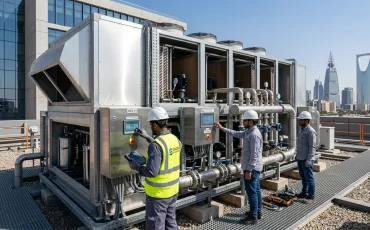
Chiller heat recovery Saudi Arabia projects work best where cooling demand and useful hot-water demand overlap for enough operating hours.
Chiller heat recovery in Saudi Arabia deserves attention because many buildings cool spaces and heat water at the same time. A hotel may run chillers for guest rooms, restaurants and public areas while boilers or electric heaters produce domestic hot water. Hospitals, laundries, sports facilities, food plants and 24-hour residential complexes can have the same overlap.
In a conventional plant, the refrigeration system removes heat from the building and rejects it through a condenser, cooling tower or outdoor coil. A separate system then buys electricity or fuel to heat water. That creates a practical question: can part of the rejected heat be captured and used to preheat domestic hot water?
The answer is often yes, but not automatically. Successful heat recovery depends on simultaneous loads, temperature, controls, storage, water hygiene, equipment compatibility and economics. This guide explains how Saudi owners and consultants should evaluate the opportunity without relying on unrealistic savings promises.
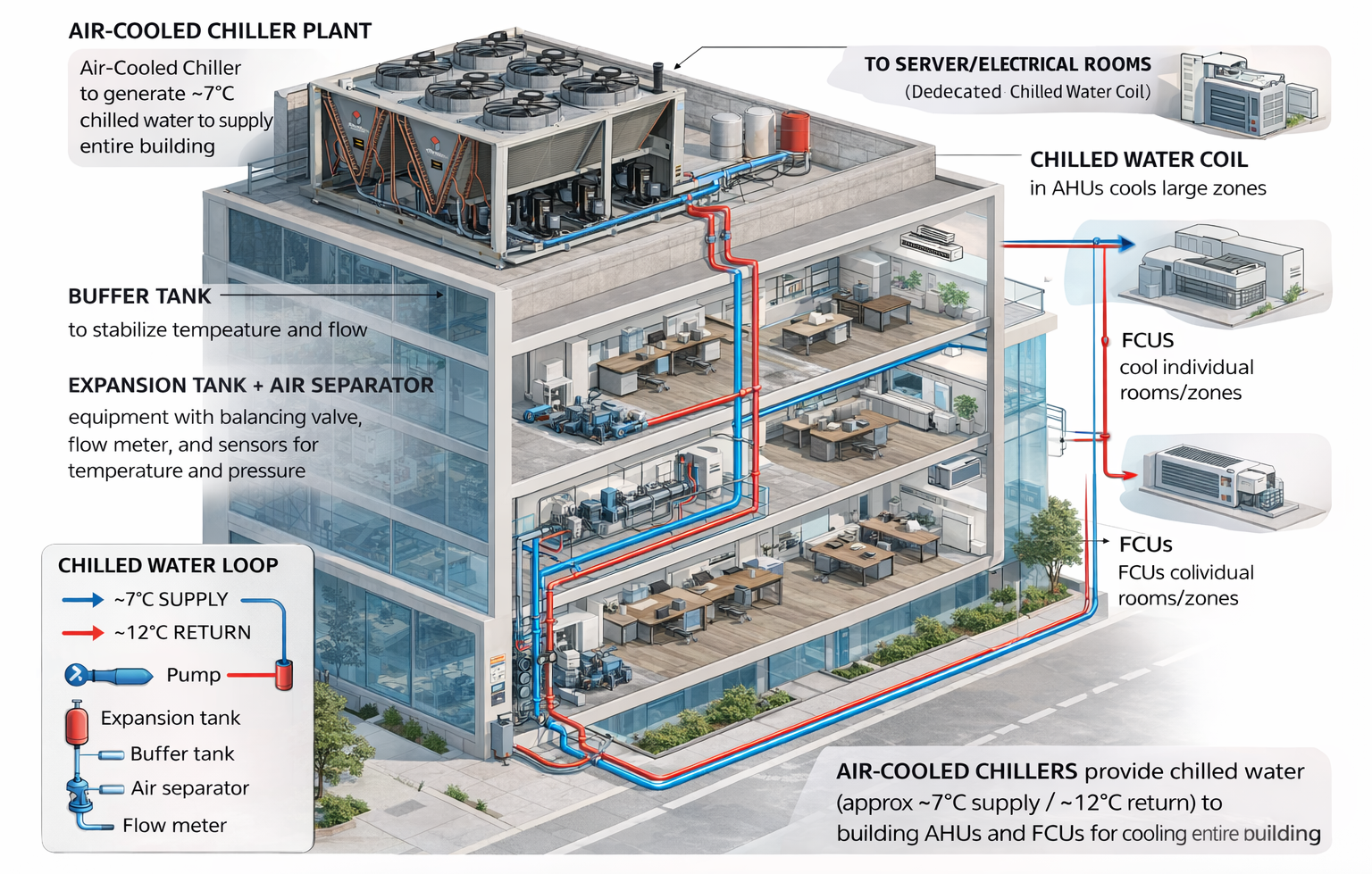
Saudi Arabia has long cooling seasons, and many commercial facilities operate around the clock. These conditions can create extended periods when the cooling plant is rejecting heat. At the same time, hotels and hospitals need hot water for guest rooms, kitchens, cleaning, laundries and clinical functions.
The strongest candidates are facilities with both a stable cooling base load and a predictable hot-water demand. Typical examples include:
A small office with little hot-water use may have plenty of condenser heat but almost no useful sink. Likewise, a building may have a large morning hot-water peak when its chillers are lightly loaded. Annual totals can look attractive while hourly overlap remains poor. That is why time-series analysis is more reliable than a simple calculation based only on installed tonnage.
A vapor-compression cooling system absorbs heat at the evaporator. The compressor adds energy, and the condenser rejects the combined heat. A heat-recovery arrangement places a controlled heat exchanger in the refrigerant or condenser-water circuit so useful heat can be transferred to a separate water loop.
A desuperheater captures high-temperature heat from compressor discharge gas before full condensation. It normally recovers only part of the total rejected heat but may provide a useful preheating temperature. The King Abdulaziz University study reports that desuperheating can represent roughly 10–20% of condenser heat rejection, with its modeled Saudi cases showing about 15% at higher superheat temperature.
A purpose-designed heat-recovery chiller can satisfy cooling and heating loads simultaneously. It may offer more recoverable capacity and higher leaving-water temperature, but selection must account for compressor lift, cooling efficiency, required hot-water temperature and the balance between the two loads.
In a water-cooled plant, heat can be recovered through an isolated heat exchanger before the remaining heat reaches the cooling towers. Isolation is essential: potable or service water should not be exposed directly to condenser water. The design also needs pumps, valves, sensors, controls, water treatment and a bypass strategy.
Recent peer-reviewed studies show meaningful potential, while also demonstrating why results cannot be generalized.
A 2025 study in Process Safety and Environmental Protection modeled heat-recovery chillers in a subtropical hotel and reported 40.44% energy savings. Another 2025 time-series study found that recovered condenser heat with thermal storage could meet service-water heating demand for 79.32% of operating time in its prototype hotel, cutting baseline boiler gas consumption by the same percentage and total modeled carbon emissions by 27.36%.
A separate 2025 hotel study optimized water flow rates and backup-heater temperature using a validated model. Its case reduced auxiliary heating use by up to 75%, with annual savings of 8,244 kWh and 10.5 tonnes of avoided CO₂.
These numbers prove technical potential, not a guaranteed Saudi result. The studies used different climates, systems, operating schedules, fuels and emissions factors. A Riyadh hotel, a Jeddah hospital and a Dammam laundry can produce very different outcomes even at similar cooling capacity.
The financial problem is easy to understand. The cooling plant uses electricity to move heat out of the building. Cooling towers or condenser fans then spend additional energy rejecting that heat. Meanwhile, a boiler, electric resistance heater or heat pump consumes energy to heat water.
Heat recovery does not make all hot water “free.” Pumps, heat exchangers, controls, maintenance and sometimes additional compressor lift have costs. Backup heating is usually still required. However, when cooling and hot-water demand overlap, recovered heat can reduce purchased heating energy and may also reduce the load sent to the heat-rejection system.
Record or model cooling demand, condenser heat rejection and hot-water draw at hourly or shorter intervals. Include weekdays, weekends, seasons, occupancy and special events. Do not size the system from chiller nameplate capacity alone.
Recovered heat must be warm enough for its intended use or useful as preheat. Higher delivery temperature can reduce chiller efficiency because the compressor works across a larger temperature lift. The best design often preheats incoming water and lets a backup system provide final temperature control.
The system should be limited by the smaller of available heat and useful demand. Oversized recovery equipment may sit idle or raise cost without increasing savings. ASHRAE’s approach is instructive: qualifying facilities size required recovery to the smaller of a fraction of peak heat rejection or a defined service-water preheat duty.
A correctly sized storage tank can shift recovered heat from periods of strong cooling to later hot-water demand. Too little storage wastes available heat; too much raises capital cost, standing loss, floor-space demand and water-management complexity.
Domestic hot-water systems require approved separation, materials, temperatures, circulation and hygiene controls. Recovered heat used for preheating does not remove the need to meet local health, plumbing and Legionella-control requirements. The final design must follow Saudi authority requirements and the project’s water-safety plan.
Controls should prioritize cooling reliability, prevent excessive condensing pressure, maintain water temperatures, manage tank charging, operate pumps only when useful heat is available and enable automatic bypass. Alarms should detect failed sensors, abnormal approach temperatures, flow loss and fouling.
Compare capital cost, pumping energy, maintenance and any cooling-efficiency penalty against avoided boiler fuel or electrical heating. Use Saudi tariffs and measured operating hours. Include scenarios for low occupancy, seasonal operation, future tariff changes and equipment degradation.
Heat recovery is a coordination problem. The BMS must know cooling load, hot-water demand, tank temperature, flow, return temperature and backup-heater status. A fixed rule may recover heat whenever a chiller runs, even when the tank is already hot or the extra compressor lift costs more than the recovered energy is worth.
Trend data can reveal whether the recovery system is working as designed. Useful key performance indicators include recovered thermal energy, recovery-system COP, percentage of hot-water load served, backup-heater energy, condenser approach temperature, cooling-tower load, pump energy and avoided cost.
For existing plants, Windmason can connect this evaluation to EcoEdgeAI and BMS optimization, subject to compatible controls and a verified engineering sequence. AI should not replace safety limits; it can optimize within them using predicted cooling and hot-water demand.
Start with measurement, not equipment selection. Review twelve months of chiller trends, fuel or hot-water electricity, occupancy and water consumption. If meters are missing, install temporary flow and temperature measurement. Then create an hourly energy balance and shortlist viable configurations.
The next stage is concept design: select the recovery point, heat exchanger, storage volume, backup-heater arrangement, pump duty and control philosophy. Check plantroom space, pipe routes, water quality, shutdown risk and maintenance access. Finally, compare life-cycle costs and commission the installation under real load.
Windmason Arabia’s HVAC consulting, contracting, maintenance and TAB services can support this process. Relevant plant context can also link to Windmason’s air-cooled chiller solutions, cooling-tower solutions and DX rooftop package systems. These links provide solution context; any project performance claim should come from approved selections and measured data.
Sometimes it can cover a large share, but a backup heater is usually retained. Coverage depends on hourly cooling operation, hot-water demand, recovery temperature, storage and controls.
Not always. Useful heat rejection can reduce cooling-tower or condenser duty, but demanding higher hot-water temperature can increase compressor lift. Evaluate the complete plant, including pumps and backup heating.
It can be, using a factory heat-recovery option or an engineered refrigerant-side solution. Equipment approval, compressor operating envelope, controls, warranty and serviceability must be confirmed.
Hotels, hospitals, laundries, kitchens, accommodation, sports facilities and industrial processes with simultaneous cooling and steady low-temperature hot-water demand are usually stronger candidates.
At minimum: hourly cooling load, chiller power and temperatures, hot-water flow and temperature, backup-heater energy, operating schedule, occupancy, tariffs and available plant space.
A useful screening study compares the hourly cooling load with the hot-water demand at the required delivery temperature. It should identify the existing heat source, storage capacity, backup arrangement and control sequence. Recovery is attractive when heat supply and demand overlap; annual totals alone can overstate value when the two loads occur at different times.
Chiller heat recovery in Saudi Arabia can turn a rejected energy stream into useful hot-water preheating, especially in 24-hour buildings with long cooling seasons. The opportunity is strongest when demand overlaps, temperature requirements are reasonable, storage is correctly sized and controls respond to real operating conditions. The right question is not “How much heat does the chiller reject?” It is “How much of that heat can the building use, at the required temperature, at the same time, at a lower life-cycle cost?” CTA: Ask Windmason Arabia to review your chiller trends, hot-water load and plant configuration. A measurement-led feasibility study can identify whether heat recovery, controls optimization or another HVAC upgrade offers the stronger business case. Contact Windmason Arabia.
ASHRAE 90.1-2022 Addendum h Yu et al. (2025), heat recovery chillers in hotels Environmental Challenges (2025), time-series heat recovery analysis Algorithms (2025), hotel hot-water optimization King Abdulaziz University Saudi AC waste-heat study IEA Heat Pump Monitor 2026
Filename: chiller-heat-recovery-saudi-arabia.webp Alt text: Chiller heat recovery system preheating domestic hot water in Saudi Arabia Filename: condenser-heat-recovery-flow-diagram.webp Alt text: Condenser heat recovery flow from chiller to hot-water storage tank Filename: hotel-hvac-hot-water-energy-dashboard.webp Alt text: Hotel HVAC dashboard tracking recovered heat and backup water-heating energy
Unique focus keyphrase and slug; no conflict with Editions #1–#25. Focus keyphrase appears in the SEO title, slug, H1, introduction, body and conclusion. Meta description is written within a typical search-snippet length. Short paragraphs, descriptive H2/H3 headings, lists and FAQs improve readability. Natural semantic keyphrases cover condenser heat, domestic hot water, hotels, hospitals and decarbonization. Contextual internal links point to Windmason services, chillers, cooling towers, DX units, EcoEdgeAI and contact.